500yr Old Inca Child Mummies Found Drugged.

Archaeologists have found three Inca child mummies dating back to 500yrs on the top of the 22,000ft summit of the Mount Llullaillco volcano in Argentina. One of the mummies found is that of a thirteen year old girl, now dubbed as the ‘Llullaillaco Maiden’, the other two mummies are that of a boy and a girl aged around four years old. The mummy of Llullaillaco Maiden is remarkably preserved whereas the remains of the boy and the girl were struck by lightning and so are charred.

The thirteen year old Llullaillco Maiden mummy which was discovered on top of a 22,000ft mountain in Argentina. Photo © Johan Reinhard.

The thirteen year old Llullaillco Maiden mummy which was discovered on top of a 22,000ft mountain in Argentina. Photo © Johan Reinhard.

The mummies were found separately entombed within a shrine, and were originally discovered in 1993 by Dr Andrew Wilson and his team of archaeologists from Bradford University. But it’s the recent findings that have spurred them into the news. The team of archaeologists analysed strands of the three mummies’ hair and discovered that in their later years they were drugged with beer and cocaine. As the Llullaillco Maiden’s hair was so long, with a centimetre of hair growth estimated per month, it allowed for an analysis that compared the alcohol and cocaine consumption during her last 21 months of life. An axial radiograph also showed that a coca leaf was held between the Llullaillco Maiden’s teeth. It is thought that she was fed the coca to subdue her during the Inca rituals.
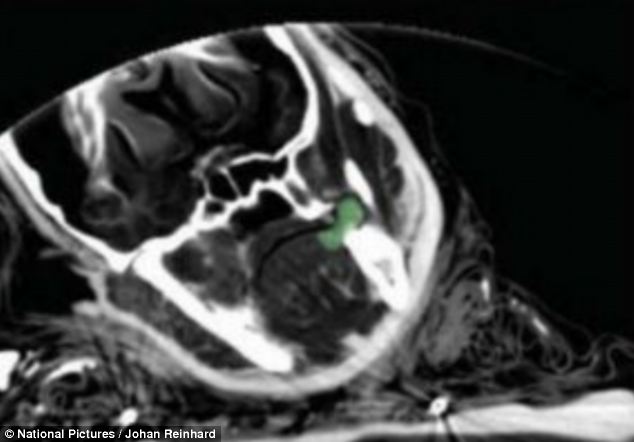
Axial radiograph of the thirteen year old mummie, shown highlighted in green is the coca leaf.

Axial radiograph of the thirteen year old mummie, shown highlighted in green is the coca leaf.

It is thought that according to Inca beliefs, the children served as guardians over their villages from the heights of the mountains. Capacocha was a ritual in which local lords were required to select unblemished children (representing the ideal human perfection), who were then married and returned to their original communities where they were honoured before being sacrificed to the mountain gods. The ritual of capacocha took place upon the death of an Inca king.

The mummies now reside in the Museo de Arqueología de Alta Montaña (MAAM) in Salta, Argentina.

References:

Daily Mail. 2013. Drugged with beer and cocaine and left to freeze to death, 500-year-old mummies of sacrificed Inca children reveal their secrets. Mail Online. Available here. 

National Geographic. 2013. Inca Child Sacrifice Victims Were Drugged. National Geographic Daily News. Available here. 

Wilson, A., Taylor, T., Ceruti, M. C., Chavez, J.A., Reinhard, J., Grimes, V., Meier-Augenstien, W., Cartmell, L., Stern, B., Richards, M.P., Worobey, M., Barnes, I., Gilbert, M.T. 2007. Stable isotope and DNA evidence for Ritual Sequences in Inca Child Sacrifice. Proceedings of the National Academy of Sicences of the United States of America. 104, 42. Pg 16456-16461. Available here. 
Quick Tips: How can you tell if a skeletal fracture is ante, peri or post-mortem?

There is a relatively easy way to see whether a fracture to a skeleton is ante, peri or even post mortem. It is essential to detail and deduce which category a fracture falls into, as this is very important to see whether the fracture had played a part in the person’s death.

To first classify a fracture, we need to understand what the different categories mean. Some of you will already know these terminology, but here’s a quick reminder;

  • If a fracture is ante-mortem, it means that the fracture was made before death of the persons.
  • With peri-mortem fractures, it means that the fracture was received at or near the time of death of the persons – so could have been the fatal strike.
  • Post-mortem fractures are fractures that have been received after death, so during the time from death to the time of recovery. These fractures are usually from excavation processes, dismemberment, or even natural processes (soil, animal and plant activity).

You will be able to determine if a bone fracture was ante-mortem due to there being signs of healing which is shown by cell regrowth and repair.

With peri-mortem fractures, the person died before the healing started to take place, but the fractures will still contain the biomechanics that are present in ante-mortem fractures.

Post-mortem breaks tend to shatter compared to peri-mortem breaks which splinter, this is because bones which are in the post-mortem stage tend to be dry and rather brittle. Another big indicator of a fracture being post-mortem is the difference in colour.

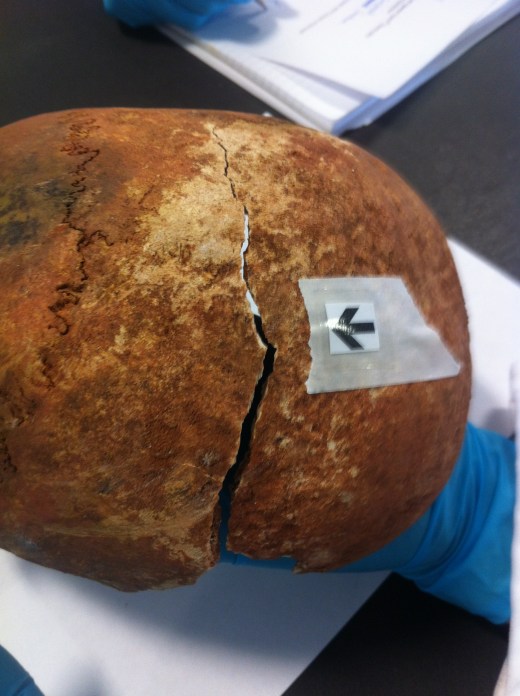
The ‘Quick Tip’ that my applied anthropology lecturer taught me on how to easily distinguish between peri-mortem and post-mortem is to look at the fracture and decide; is it a clean break, as if you were breaking in half a bar of chocolate? If it is, then the fracture is most likely to be a peri-mortem fracture. If the break looks crumbly, like breaking a biscuit in half, it’s post-mortem fracture. Obviously this tip is not the most scientific, but it’s an easy way to begin your distinguishing process.

Image

Skull with signs of post-mortem fractures. This photo is from a practical lab session.

If you look at the photo above it illustrates a post-mortem fracture. You can determine this easily due to the colour difference on the edge of the fracture, where it is a much lighter colour compared to the rest of the skull and the crumbly nature of the cut.

References:

Most of this is my own knowledge that I learnt during my degree in my anthropology lectures/lab practical sessions. But if you’re looking for a published journal check the one below. It is very informative and easy to understand if you’re a beginner in the world of anthropology/archaeology! It also highlights some problems that can arise when distinguishing trauma, it’s really interesting!

Smith, A.C. 2010. Distinguishing Between Antemortem, Perimortem, and Postmortem Trauma. Academia.edu. Available from here in .pdf form!

Read more anthropology/archaeology quick tips here!

Well Preserved Dinosaur Tail Found in Mexico.

A team of archaeologists and students from of the country’s National Institute for Anthropology and History (INAH) have found a remarkably well preserved fossilised remains of a suspected dinosaur tail, near the town of General Cepeda, Coahuila in northern Mexico. The director of the INAH, Francisco Aquilar, has said that the tail, which has been measured to be five yards long, is the first one of its kind to be found in Mexico. The tail was identified to be belonging to a hadrosaurid ( a duck-billed dinosaur), where it is likely representative of  half the dinosaurs full length.

Top: The fossilised tail remains of the hadrosaur, recently discovered in northern Mexico.  Bottom: A electronic  artist rendering of the appearance of the suspected dinosaur.

Top: The fossilised tail remains of the hadrosaur, recently discovered in northern Mexico.
Bottom: A electronic artist rendering of the appearance of the suspected dinosaur.

But this tail hasn’t been the only fossilised remains of dinosaurs that they have found on this archaeological site. The archaeologists have also found what is suspected to be one of the dinosaurs hips. There have also been numerous dinosaur remains found within the state of Coahuila, with Aguilar noting that they have “a very rich history of paleontology” within that area.

There was an earlier fossilised remains discovery in 2010. The fossilised remains were of a never before discovered dinosaur within the same northern Mexico state as the recently discovered tail. The remains of the Coahuilaceratops, which was aptly named after the place of discovery, was discovered by a research group of palaeontologists from the Utah Museum of Natural History at the University of Utah. The excavation of the Coahuilaceratop marked the unearthing of the first horned dinosaur ever to be discovered in Mexico (News Center, 2010).

References:

Daily Mail. 2013. What happened to the rest of it? Archaeologists discover a 72million-year-old dinosaur tail in Mexican desert. Daily Mail News Online. Click here for an article about the dinosaur tail.

News Center. 2010. First Horned Dinosaur from Mexico. University of Utah. Available here. 

Unusual-ology is a new post type which focuses on weird new articles/science areas that have cropped up and caught my eye.

To read the Unusual-ology post on the Ancient Egyptian use of lettuce as an aphrodisiac, click here, or how male spiders sacrifice themselves to their mate, click here. Looking for an interesting article on the recent vampire burials, and past vampire burials, clickety click here.

Unusual-ology: Unexpected Items in the Bagging Area…

Unusual-ology is a new post type which focuses on weird new articles/science areas that have cropped up and caught my eye.

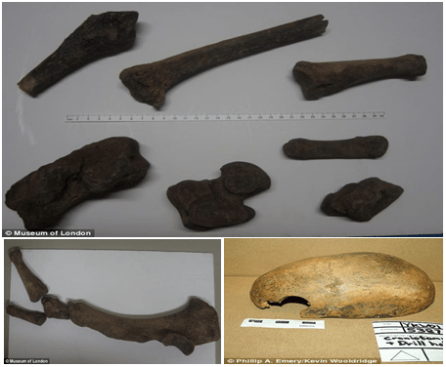
Archaeologists have made a very peculiar discovery in a churchyard near the St Pancras train station in London. The researchers, led by Phil Emery from Ramboll Cultural Heritage and Archaeology, have stumbled upon a coffin dating back between 1822 and 1858.  What has made the coffin so strange is that it had a large selection of bones from many different animals mixed among human remains. Within the coffin were nine bones from a Pacific walrus (Odobenus rosmarus divergens), eight mixed sets of human remains – including three skulls, and a tortoise.

Image

Top: Collection of the walrus bones. Bottom Left: The walrus’ back right leg. Bottom Right: The skull showing visible signs consistent with craniotomy.

The coffin was originally discovered in 2003 during excavations of the horizontal burial trench underneath the station, when the Eurostar terminal moved from Waterloo to St Pancras. Emery & Wooldridge (2011) have noted that the bones discovered have marks which are consistent to dissection, which was legalised by the Anatomy Act of 1832, with one skull showing evidence of craniotomy (drilling a hole in the skull to gain access to the brain). As the animal bones were found alongside human remains, Emery believes that the bones were used as a teaching collection from a research institute and has said that:

“The animal bone consisted of a small, moderately-preserved group of eight bones derived from a walrus of a very large size and robust build.’The sample includes bones from a lower fore-limb, a fore-foot, first and second metacarpal, the lower hind limbs, fibula, calcaneum, astragalus and first cuneiform. These bones are significantly larger than their reference equivalents held at the Natural History Museum. Microscopic examination revealed that all the St Pancras walrus bones show some degree of surface erosion and butchery marks. Three clear superficial transverse knife cuts were noted.”

The walrus bones have now been moved to the London Archaeological Archive and Research Centre in Hackney, East London.

If you’ve enjoyed this new ‘Unsual-ology’ post feature – leave a comment or a like!

If you want to read more unusual science posts click here, or to read the Unusual-ology post on the Ancient Egyptian use of lettuce as an aphrodisiac, click here. Or to read about the newly discovered ‘Entrance to Hell’ click here!


References:

Daily Mail. 2013. The ongoing mystery around how a Pacific walrus ended up buried in a human coffin beneath London’s St Pancras station. Daily Mail News. Article available here.

Emery, P., Wooldridge, K. 2011. St Pancras burial ground: excavations for St Pancras International, the London terminus of High Speed 1, 2002–3. Gifford, London. This book can be found here. 

Telegraph. 2013. Walrus remains found buried under St Pancras station in London. Telegraph News. Available from here.

Unusual-ology: Male Spiders Self Sacrifice for Better Offspring.

Unusual-ology is a new post type which focuses on weird new articles/science areas that have cropped up and caught my eye.

The practice of monogyny is found throughout the insect kingdom, especially arachnids. One such arachnid is the make dark fishing spider (Dolomedes tenebrosus). A recent study in Biology Letters has discovered that the male arachnid willingly sacrifices itself to the female to ensure that the resulting offspring is healthy; by providing itself as a meal for the female.

Video of the mating rituals and cannibalism from the experiment – Royal Society of Journals

Schwartz et al (2013) think that this practice of sexual cannibalism may provide an ‘evolutionary advantage’, because a better fed female is more likely to provide healthy descendants. But there are certain drawbacks to this practice; if a male dark fishing spider accidentally prematurely triggers one of their pedipalps, their two feeler-like appendages near the mouth where sperm is stored, they can die. Schwartz has encountered many problems during his experiment while catching the wild male specimens; they would accidentally snag their pedipalps on a piece of cotton which would cause them to die before the experiment could take place.

References:

National Geographic. 2013. Male Spiders Self-Sacrifice, Lose Genitals. National Geographic News. Click here for the article.

Schwartz, S.K., Wagner Jr, W.E., Hebets, E., A. 2013. Spontaneous male death and monogyny in the dark fishing spider. Biology Letters. 9, 4. Click here for the journal.

If you’ve enjoyed this new ‘Unsual-ology’ post feature – leave a comment or a like!

If you want to read more unusual science posts click here, or to read the Unusual-ology post on the Ancient Egyptian use of lettuce as an aphrodisiac, click here. Or to read about the newly discovered ‘Entrance to Hell’ click here!

Unusual-ology: Ancient Greek and Roman “Entrance to Hell” discovered.

Unusual-ology is a new post type which focuses on weird new articles/science areas that have cropped up and caught my eye.

Italian archaeologists from the University of Salento, led by Francesco D’Andria, working at a Greco-Roman site of ancient have discovered the ‘Entrance to Hell’.

ImageHieropolis, known today as Pamukkale, Turkey – where the “Entrance of Hell” has been located.

This ‘Entrance to Hell’ has been discovered in Hierapolis, known today as Pamukkale, in Turkey.  Francessco and the fellow archaeologists were able to stumble upon the entrance of the temple by tracing the path of the hot springs through the ancient site. The temple, identified as the Ploutonion, has been linked to Hades and correctly identified due to an ‘engraved dedication’ to Pluto above the gate. The temple was built over a cave and underground in the thermally active area. Ploutonion was the worship ground for many ancient pilgrims who would travel to celebrate their gods and bathe within the hot springs that surround the area.

The reason why the Ploutonion has been called the ‘Entrance to Hell’ is due to the writings of the Greek geographer Strabo. Strabo mentions about the “opening of sufficient size to admit a man, but there is a descent to a great depth… The space is filled with a cloudy and dark vapour, so dense that the bottom can be scarcely be discerned.” These documents explain that the cloudy, dark vapour has caused many animals that enter to die instantly. Strabo wrote that Bulls which had entered the Ploutonion “fell down and were taken out dead” and sparrows which were thrown inside “immediately fell down lifeless.” The Ploutonion’s poisonous vapour still survives today as many dead birds have been found on this site during modern excavations. The presence of the dead birds has helped convince the archaeological team that this is in fact Ploutonion’s true ‘entrance to hell’.

If you’ve enjoyed this new ‘Unsual-ology’ post feature – leave a comment or a like!

If you want to read more unusual science posts click here, or to read the Unusual-ology post on the Ancient Egyptian use of lettuce as an aphrodisiac, click here!

References:

Biblical Archaeology Society. 2013. Hierapolis and the Gateway to Hell. Bible History Daily News. Click here for the article, and to read more of Strabo’s writing on the Ploutonion.

Daily Mail. 2013. Is this the Gate of Hell? Archaeologists say temple doorway belching noxious gas matches ancient accounts of ‘portal to the underworld’. Daily Mail News. Click here for the article.

National Geographic. 2013. Archaeologists Find a Classic Entrance to Hell. National Geographic Daily News. Click here for the article.

Unusual-ology: Lettuce, an ancient Egyptian sex symbol?

Unusual-ology is a new post type which focuses on weird new articles/science areas that have cropped up and caught my eye.

Can this key ingredient to salads actually be considered a sex symbol? Well Salima Ikram, an Egyptologist from the American University of Cairo, has claimed that lettuce was viewed as an aphrodisiac by ancient Egyptians, where they also used it as a phallic symbol.

Image

Min – the Egyptian god of fertility and lover of lettuce.

So how did a distant species of our modern day lettuce become a sexy vegetable? On numerous tomb walls, dating back to 2,000BC, there are images of lettuce which have been connected to the Egyptian god of fertility – Min, who can be found depicted with an erect penis on numerous hieroglyphs. It is thought that lettuce was Min’s favourite food, and this vegetable helped him perform sexual acts without becoming tired. Many ancient Egyptians wouldn’t have utilised lettuce in meals like we commonly do, but often as an aphrodisiac.

References:

Daily Mail. 2013. The land where LETTUCE was a sex symbol: Leafy vegetables were taken as an aphrodisiac in ancient Egypt and considered a delicacy of the god of fertility. Daily Mail Online. Click here for the article!

Ikram, S. 2012. Food, drink, and feasting (Egypt). The Encyclopaedia of Ancient History. Blackwell Publishing. Can be viewed here in .pdf– if you have a Wiley Online account.

If you’ve enjoyed this new ‘Unsual-ology’ post feature – leave a comment or a like!

If you want to read more unusual science posts click here!

Quick Tips: The Use of 3D Animation to Visualise a Crime Scene in Forensics.

Many television programs create 3D animations and computer generated images using highly technical computer programmes to help re-enact the scenes or time frame of a crime. This is mostly used so that the viewer at home can really grasp what crime has been committed and help establish a sense that they are a witness. But in reality these animations and images are becoming an increasingly popular technique used within the courtroom.

Information and evidence can be easily constructed from the traditional methods of forensic photography, blood spatter analysis and eye witness testimonies. But in this modern technological time the information gathered is now being used to create computerised animation that depicts the series of events within a crime. But is this method of providing visual appropriate and correct? Could the animation be showing a display of actions/movements that humans can’t possibly and physically make?

There is a big issue with admissibility, which can cause bias. This occurs when the jurors or judge aren’t aware of an error/uncertainty within the procedure of recreating a real life scene into animation. This can cause them to believe that the evidence is a hundred per cent correct, when in fact there are many errors which were created in the process or animation (Ma & Zheng, 2010). Another big problem arises when studies found that people are five times more likely to remember something they see and hear rather than hearing alone. People are also twice as likely to be persuaded if the arguments are backed with visual evidence (Lederer & Solomon, 1997). So this poses a huge problem as false memories and false testimonies could be influenced, which in the end could cause an innocent person to go to jail for a crime they did not commit.

So with the possibility of creating false memories is the use of 3D animation beneficial for the use of visualising crime scenes within court? It is argued that it is as the use of computerised images creates a higher level of accuracy and speeds up the forensic investigational process but only in major crime types, not every day homicides and robberies. However even though it has limited application in the courtrooms,  it can pose to be very useful in formal briefs with the forensic personnel, and within the backstage elements of the investigation itself (Ma & Zheng, 2010).

References:

Lederer FI, Solomon SH. 1997. Courtroom technology – an introduction to the onrushing future. Fifth National Court Technology Conference: National Centre for State Courts. Available here.

Ma M, Zheng H. 2010. Virtual Reality and 3D Animation in Forensic Visualization. Journal of Forensic Sciences. 55, 5. 1227-1231.

New Evidence Supports Conflict is Not Innate.

In a previous post – which can be found by clicking here – I had examined whether conflict was innate for humans after a lecture in University, which I concluded was true by analysing different theories but stressed that conflict only becomes active due to a stimulus. That stimulus could either be biological, seen in aggressive mating, or environmental, such as intraspecific/intrespecific competition. But a recent study, noticed by the BBC has put a spanner in the works, as the leading researcher – Patrik Soderberg – says that conflict isn’t actually innate.

Soderberg’s research based its findings by studying isolated tribes from numerous places around the world which had been studied over the last century. By using modern primitive isolated tribes they were able to have a sample which was cut off from the modern day life and utilising the wild plants and animals that inhibit their environment, surviving like the much older hunter-gatherers.

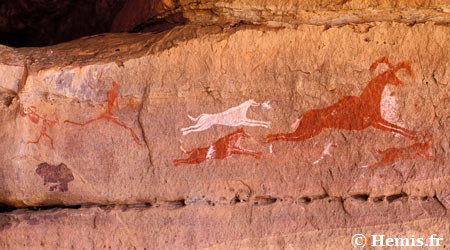
Ancient hunter-gatherer cave art.

Ancient hunter-gatherer cave art.

Using these modern day tribes as an analogy for the earlier societies that ruled the lands, they assessed and analysed any violent deaths. They found that in their sample populations there were 148 violent deaths, but very few were caused by widespread war. Most of the violent deaths were caused by personal motives ranging from family feuds or adultery.

Soderberg has admitted that these modern tribes were not a ‘perfect model’ for the ancient civilisations but said that due to vast significant similarities they did allow for an insight into the past. From this study he concluded that war may have developed later as the hunter gathers became more agriculture orientated and territorial with a complex social structure. “As humans settled down, then war becomes more dominant and present. For these primitive societies, war has not yet entered the picture,”.

References:

BBC. 2013. Primitive human society ‘not driven by war’. BBC News. Available here.

Soderberg, P., Fry, D. 2013. Latest Skirmish Over Ancestral Violence Strikes Blow for Peace. Science. 341, 6143. P224. Here is a link to view the .pdf of this very interesting article.

Tsunami in Japan claims lives of many endangered species.

The recent 2011 tsunami and earthquake in Japan delivered mass destruction across the Japanese mainland and notably the capital Tokyo. The tsunami claimed many lives of the population residing on the coast and caused millions of pounds worth of damaged.

A recent BBC (2011a) news story has highlighted that humans were not the only species of animal affected by this natural disaster. Thousands of albatrosses were killed when the destructive waves hit a wildlife sanctuary north-west of Hawaii. The sanctuary based on the Midway Island, which is the home of the vulnerable Laysan albatross (Phoebastria immutabilis), was first created after US Naval Air facility was shut down in 1993.

The US Fish and Wildlife Service reported that 1,000 adult and adolescent Laysan albatross were killed when the 1.5metre high waves hit the National Wildlife Refuge (NWR). Along with the 1,000 adults approximately tens of thousands of chicks were killed when nearly 60% of the island was covered by the huge waves.

The Laysan albatross weren’t the only species of animals that was damaged by the effects of the tsunami. The population of Bonin petrels (Pterodroma hypoleuca) took a damaging blow when they were buried alive. Bonin petrels are ground nesting so live in burrows underground so scientists are uncertain about how many were affected. Scientists at the NWR were hoping that they were out foraging for food as they feed at night when the tsunami’s waves washed over the island at dawn (Yahoo, 2011). The impact of the tsunami on other species such as the Laysan ducks and monk seals are currently unknown by wildlife conservationists (BBC, 2011a).

Along the survivors of the killer waves was a 60 year old Laysan albatross named Wisdom who recently hit the news headlines as the ‘Oldest bird in the US’ after she was found mothering a chick (NYTimes, 2011). The US Geological Survey (USGS) first ring tagged Wisdom in 1956 when she was incubating an egg. It is estimated that over the past 54 years she has mothered over 30-35 chicks (BBC, 2011b).

This demonstrations that natural disasters not only damage the human race but they also put other species, which are already close to being endangered, even closer to extinction.

References:

BBC. 2011a. Japan tsunami: Thousands of seabirds killed near Hawaii. BBC News.

BBC. 2011b. ‘Oldest bird in US’ raises chick. BBC News.

NYTimes. 2011. Albatross Is a Mother at 60. The New York Times.

Yahoo. 2011. Tsunami killed thousands of seabirds at Midway. Yahoo News.