Unusual-ology: ‘Vampiric Burials’ – The archaeological evidence that supports the supernatural myths.

Unusual-ology is a new post type which focuses on weird new articles/science areas that have cropped up and caught my eye.

A recent news story, which can be viewed here, has brought to the attention of the public the topic of ‘vampiric burials’, due to the discovery of a 16th/17th century ‘vampiric burial’ in Poland.  These burials have been linked to vampire activity due to the unconventional layout of the skeletal remains – the occupants of the graves had been decapitated with their head placed between their legs. This activity of decapitating a suspected vampire had evolved from the European folk belief that decapitation is the only way to ‘keep the undead dead’. But this is not the first instance of the discovery of these superstitious burials.

Vampire Burials - Decap

The occupants of the graves had been decapitated with their head placed between their legs.

Another ‘vampiric burial’ was found in Venice during a research project on mass graves located in Nuovo Lazzaretto, where the corpses were from numerous plague deaths. One skeletal remains that stood out was that of a woman. The peculiar thing about this corpse was that a brick of moderate size was placed within her oral cavity, keeping her mandible wide open (Nuzzolese & Borrini, 2010).
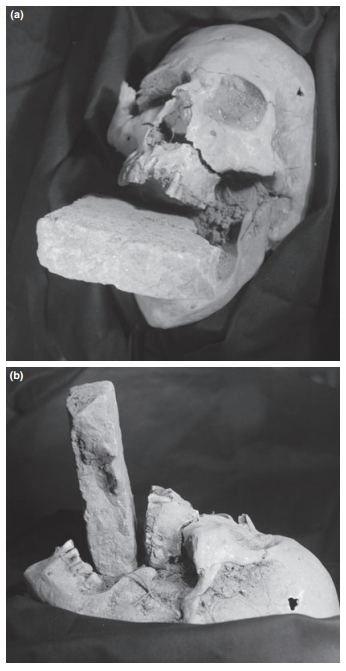
Positioning of the piece of brick placed in the skeleton's oral cavity.

Position of the piece of brick placed in the skeleton’s oral cavity.

The positon of the brick was ruled out to be accidental, it wasn’t a piece of sediment that just happened to have fallen into place – it had been purposely placed there, but why? Nuzzolese & Borrini (2010) hypothesise that this is part of a symbolic burial ritual of which the gravediggers practice when there was a suspected vampire – who they thought could have been the cause for the plague ravishing their village.

Europe isn’t the only place to have encounters with ‘vampire graves’. A journal dating back ten years addressed America’s, more specifically New England, vampire folk beliefs using bioarchaeological and biocultural evidence. Sledzik & Bellantoni (1994) examined how folk beliefs associated with death and disease can impact archaeological records from their use of unusual post-mortem actions. In this study Sledzik and Bellantoni focused on a single 18/19th century male skeleton, known as J.B, aged between 50 to 55 years old. They chose J.B due to his skeletal remains being rearranged; the bones of his chest disrupted and his skull femoral placed in a “skull and crossbones” position.  J.B had died from either tuberculosis or a pulmonary infection – which was interpreted as tuberculosis, also known as consumption at the time of death.  It’s hypothesised that fellow family members, seven years later, contracted tuberculosis. The family assumed that the deceased male had returned from the dead and had ‘fed’ on them. From this notion, the family exhumed the corpse of J.B to kill the ‘undead’, keeping with the New England belief of killing a vampire by burning their heart. When they exhumed J.B. and found his body decomposed and missing his heart – which could then not be burnt – they decided the best course of action was to disrupt his corpse to stop reanimation.

So the discovery of the Polish vampire graves may have shot vampire burials into the limelight, but this isn’t the first archaeological case of superstitious vampire burial rituals, and it won’t be the last.

References:

Daily Mail. 2013. Archaeologists unearth ‘vampire graves’ containing decapitated skeletons with skulls placed between their legs on Polish building site. Daily Mail News.

Nuzzolese, E., Borrini, M. 2010. Forensic Apporach to an Archaeological Casework of “Vampire” Skeletal Remains in Venice: Ondontological and Anthropological Prospectus. Journal of Forensic Sciences. 55, 6. p1634-1637.

Sledzik, P., Bellantoni, N. 1994. Brief Communication: Bioarchaeological and Biocultural Evidence for the New England Vampire Folk Belief. American Journal of Physical Anthropology. 94, 2. p269-274.

If you’ve enjoyed this new ‘Unsual-ology’ post feature – leave a comment or a like!

If you want to read more unusual science posts click here!

Unusual-ology: How to get A-Head in Medieval England.

 This is a recap of lecture which I attended during my degree. It focused on an extremely weird case study which the lecturer had been presented with, a skull which had preserved soft tissue with ‘links to medieval witchcraft’. 

Within this lecture we were presented with a case study of a skull which had preserved soft tissue. The lecturer talked about how he had stumbled on this rare artefact in a peculiar museum which dealt in Wiccan and witchcraft. There it had a story allocated to it to entice an audience and raise curiosity.

This story was of medieval origins where brutal executions took place. This skull belonging to an execution victim was stored in a Church inside a wooden box covered in numerous markings of figures in communal scenes; these figures are depictions of ‘Green Men’. Intrigued by these mysterious figures and why they appeared on a wooden box along with scrape marks, I decided to do some research of my own. I found that ‘Green Men’ are deities of nature Gods which are often found within Churches and a symbol of pre-Christian religions often in Pagan origin. Could this skull have been kept as a relic? Does it belong to an important figure from medieval times? But after the War was it stolen from the Church and sold onto this museum?

What was peculiar about it was the preserved tissue only found on bodies in extreme conditions such as heat or cold or bodies submerged in bogs. The initial thought was “Could this marvellous story be true? It is a modern day fake, or is it something totally different? Or is it actually a mummy?”

What first stood out was that the skull had remains of eyes which mummies do not possess at the time of burial. Also from examining the skull and comparing the skulls to known parameters it was discovered to be the skull of a 35 to 45 year old woman. More tests were run using modern day technology such as MRI scans and CT scans, the MRI scan failed to show anything due to the lack of hydrogen atoms within the skull due to the dehydrated state it has deteriorated to. But there were surprising results from the CT scan which showed that there was a grey area in the back of the skull, could this be preserved brain? It turned out it was actually tree sap, which backs up the theory that this skull is actually a mummy. Egyptians used pine resin to preserve the bodies as its more ‘sacred’ than glue. There was also evidence that the septum of the skull had been broken by something, which is common in the procedure for mummification. To get a definitive answer to this riddle the final step was to use carbon dating; this helped determine that the skull is in fact a mummy and not a medieval relic or execution victim.

The use of all these modern technologies, theories and knowledge gained from previous case studies helped shine a light on the true origins of this skull. Other artefacts have been found to be something they’re not and are now being traced back to their true beginnings and having a new story assigned to them, for the future generations to be marvelled just as I was during this riveting lecture.

If you’ve enjoyed this new ‘Unsual-ology’ post feature – leave a comment or a like!

Welcome!

Hello and welcome to All Things AAFS!

This blog will discuss and dissect topics of contemporary sciences consisting of journals, published articles or even news that I have stumbled across and wish to expand on.

After finishing my BSc (Hons) degree I have embarked on this task to ensure that I stay up to date with all things AAFS and related to my degree. A few posts on this site will be from lectures or assignments that were set during the course of my degree, which I found fascinating so wish to share with others who are passionate about anything related to archaeological, anthropological and forensic sciences.

Well I hope you enjoy these insights into my experiences in the AAFS world and find them interesting.

Rosie.

Me during DBD'11


Me, inside my designated pit during the DBD’11 Archaeological dig held yearly by Bournemouth University.