Textbook of the Week: Archaeology: Theories, Methods & Practice.

Every week we highlight one archaeology/anthropology textbook from our suggested readings, a full list of our suggested resources can be found here, on our Useful Literature page.

ImageArchaeology: Theories, Methods and Practice (UK/Europe Link)

Archaeology Essentials: Theories, Methods, and Practice (Second Edition) (US/Worldwide Link)

by Colin Renfrew and Paul Bahn. Rating: *****

“This book is highly acclaimed and is the ultimate archaeology bible for students, or people new to archaeology and want to get stuck right in. After being recommended it by two of my University lecturers, I took it out from the library to use for my assignments so many times I ended up buying it.”

If you’re new to the realm of archaeological, anthropological and forensic sciences (AAFS), or are a student needing sturdy and reliable references, or wondering “what archaeology or anthropology textbooks to buy? Check out our new ‘Useful Literature’ page!

Image

Quick Tips: How To Estimate The Chronological Age Of A Human Skeleton – Pubic Symphyseal Surface Method.

This Quick Tips post is the fifth in the series on age estimation on skeletal remains, if you haven’t read the previous post click here, or to start at the beginning click here. The previous post provides an overview of the cranial suture method of aging, whereas the first post covers the basics.

This method is one of the most common ways of chronically aging a human skeleton, and involves examining the surface of the pubis of the os coxae.

Over a lifetime the surface of the pubis change; in early adulthood the surface is rugged and is traversed by horizontal ridges and intervening grooves. By the age of thirty-five, the surface becomes smoother bound by a rim, as it loses relief. The pubic symphysis of an adult over the age of thirty-five, continues to erode and deteriorate with progressive changes.

These changes were first documented by Todd (1920) who conducted a study on 306 males of known age-at-death. Todd identified that there were four parts to the pubic symphysis, where he noted evidence of billowing, ridging, ossific nodules, and texture:

  1. The ventral border (rampart).
  2. The dorsal border (rampart).
  3. The superior extremity.
  4. The inferior extremity.

Using his observations, Todd identified ten phases of pubic symphysis age, ranging from eight/nine-teen years old to fifty-plus years.

Image

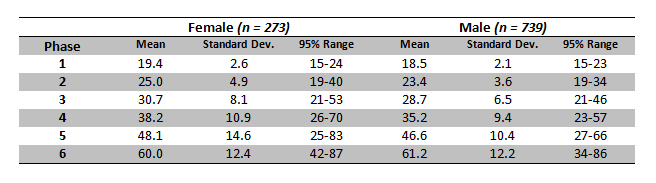
After Todd’s (1920) method which only looked at males, Suchey-Brooks (1990) undertook a study that involved both female and male pubic symphyses – which allowed for a new symphysis scoring system to be created. This new scoring system is made up of six phases, which have a corresponding statistical analysis for the age that each stage represents. The six stages are as follows:

  1. Lack of delimitation of either superior/inferior extremity; Symphyseal face has a billowing surface (ridges and furrows), which usually extends to include the pubic tubercle. The horizontal ridges are well-marked, and ventral bevelling may be commencing. Although ossific nodules may occur on the either extremity.
  2. Surface has commencing delimitation of lower and/or upper extremities occurring with or without ossific nodules; Symphyseal face may still show ridge development. The ventral rampart may be in beginning phases as an extension of the bony activity at either or both extremities.
  3. Ventral rampart in process of completion; There can be a continuation of fusing ossific nodules forming the upper extremity and along the vetral border. Symphyseal face is smooth or can continue to show distinct ridges. Dorsal plateau is complete. Absence of lipping of symphyseal dorsal margin; no bony ligamentous outgrowths.
  4. Oval outline is complete, but a hiatus can occur in upper ventral rim; Symphyseal face is generally fine grained although remnants of the old ridge and furrow system may still remain. Pubic tubercle is fully separated from the symphyseal face by definition of the upper extremity. The symphyseal face may have a distinct rim. Ventrally, bony ligamentous outgrowths may occur on inferior portion of pubic bone adjacent to symphyseal face. If any lipping occurs, it will be slight and located on the dorsal border.
  5. Symphyseal face is completely rimmed with some slight depression of the face itself, relative to the rim; Moderate lipping is usually found on the dorsal border with more prominent ligamentous outgrowths on the ventral border. There is little or no rim erosion. Breakdown may occur on superior ventral border.
  6. Symphyseal face may show on-going depression as rim erodes; Ventral ligamentous attachments are marked. In many individuals the pubic tubercle appears as a separate bony knob. The face may be pitted or porous, giving an appearance of disfigurement with the on-going process of erratic ossification. Crenulations may occur. The shape of the face is often irregular at this stage.
Image

Figure 2: The Suchey-Brooks pubic symphasis scoring system of the six stages. It is recommended that these illustrations be supplemented by casts before actual aging is attempted.
Image

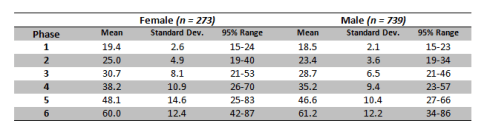
Table 1: Statistics for the Suchey-Brooks phases in females and males.

This pubis symphyseal surface method is often preferred over the other aging methods due to the age-related changes on the pubis surface continuing after full adult stature has occurred, for example; epiphyseal closing method can only age early adulthood.

References:

Buikstra, J.E., Ubelaker, D.H. 1994. Standards for Data Collection From Human Skeletal Remains.Fayetteville, Arkansas: Arkansas Archaeological Survey Report Number 44.

Todd, T.W. 1920 Age changes in the pubic bone: I. The white male pubis. American Journal of Physical Anthropology, 3: 467-470.

White, T.D., Folkens, P.A. 2005. The Human Bone Manual. San Diego, CA: Academic Press. Pg 360-385.

If you’re new to the realm of archaeological, anthropological and forensic sciences (AAFS), or are a student needing sturdy and reliable references, or wondering “what archaeology or anthropology textbooks to buy? Check out our new ‘Useful Literature’ page!

Image

Ancient Egyptian Brewer Tomb Unearthed.

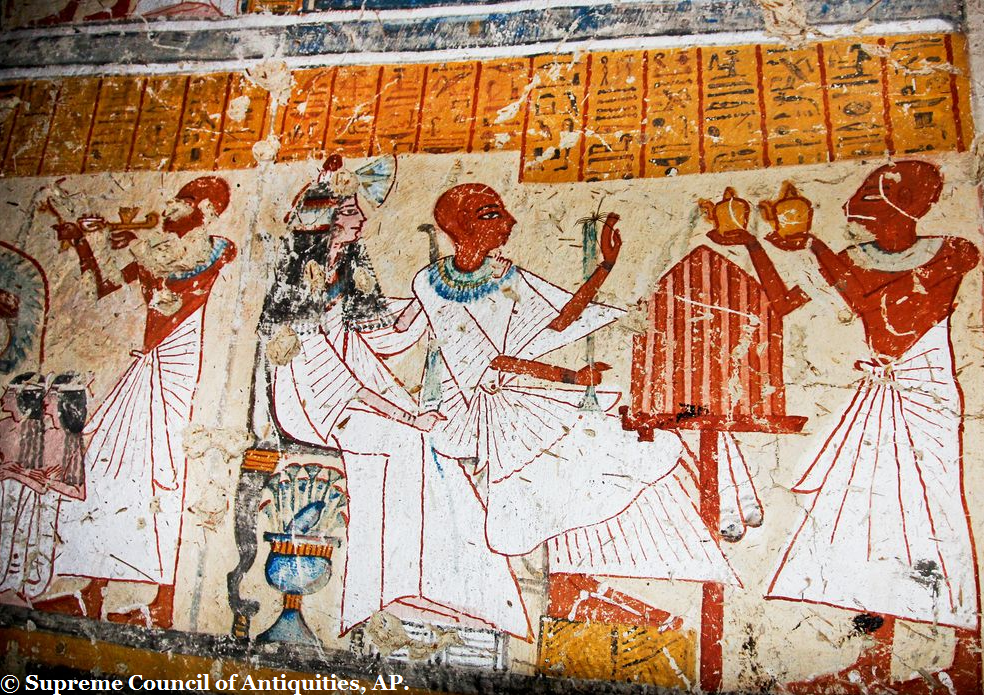
A magnificent painted tomb belonging to an ancient Egyptian brewer has been discovered on the west bank of the Nile.

The painted T-shaped tomb is said to belong to Khonso Im-Heb, who is documented as being the head of granaries and beer-brewing for the worship of the Egyptian goddess, Mut.

Image

Khono Im-heb, bare-headed, and his wife depicted in two rituals with Egyptian gods: Osiris (top left), and Anubis (top right).

The images that line the walls of the tomb illustrate numerous scenes of daily life, giving us an insight into the activities that occurred 3,000 years ago. The paintings colourfully show Khonso Im-Heb interacting with his wife and children, and their ritual practices for their worship of Mut.

Image

Khonso Im-Heb and his wife being presented with an offering from their son.

The burial chamber was found in El Khokha, in the Valley of the Kings near the royal tombs. The tomb was unearthed by Japanese archaeologists, led by Jiro Kondo, from the Waseda University in Tokyo in December 2007.


If you’re new to the realm of archaeological, anthropological and forensic sciences (AAFS), or are a student needing sturdy and reliable references, or wondering “what archaeology or anthropology textbooks to buy?” Check out our new ‘Useful Literature’ page!

Share Post Sign

Aztec ‘Human Sacrifice’ Remains Found Under Mexico City Subway.

Archaeologists who surveyed a Mexico City subway in order for an extension to be performed have announced they made a startling discovery – unveiling what is thought to be remains of Aztec sacrifices.

Image

One of the human remains found at the excavation site which was thought to be a human sacrifice – with offerings beside them.

The team of archaeologists, led by Maria de Jesus Sanchez from the Mexico’s National Institute of Anthropology and History (NIAH), have unearthed a dog’s skull with holes in it. As well as the dog skull, a female’s skull and two male skulls with the same indents were also found in close proximity.

It is thought that these skulls are the remains are from Aztec offerings, due to the bizarre nature of the holes that perforate the skulls. It is thought that these holes would have allowed the skulls to be displayed on a rack, known as a tzompantli, for the public to see. Tzompantli were commonly used within the ancient Aztec world for displaying the severed heads of captured warriors, who were sacrificed as an offering to the Gods.

The skulls have been dated back to between 1350 and 1521, and the discovery of the dog’s skull with such punctures is the first of its kind according to the NIAH, making it a very important find. It is thought that the dog was sacrificed because in some pre-Hispanic beliefs, a dog can accompany its owner in the afterlife.

Image

The human skull, center, and dog skull, top right, that was discovered at the site.

But these skulls weren’t all that was found during this excavation – one hundred burials were also uncovered with the majority of the skeletons being juvenile.

References:

  • NIAH. 2013. SKULLS OF A ‘TZOMPANTLI’ BETWEEN FINDINGS ON METRO LINE 12. Archaeology – Bulletins. Available here.

If you’re new to the realm of archaeological, anthropological and forensic sciences (AAFS), or are a student needing sturdy and reliable references, or wondering “what archaeology or anthropology textbooks to buy?” Check out our new ‘Useful Literature’ page!

Share Post Sign

Useful Literature.

Image

If you’re new to the realm of archaeological, anthropological and forensic sciences (AAFS), or are a student needing sturdy and reliable references, or wondering “what archaeology or anthropology textbooks to buy?”
On our ‘Useful Literature’ page you can find links to the full selection of the best textbooks – most of these have been suggested to me by my university Professors.

Here is a short-list of the most helpful student books for archaeology and anthropology:

Quick Tips: Archaeological Techniques – Ground Penetrating Radar.

Ground-penetrating or probing radar (GPR) is a non-destructive, geophysical method that uses radar pulses to image the subsurface. The principles of ground-penetrating radar are similar to reflection seismology, except that electromagnetic energy is used instead of acoustic energy, and reflections appear at boundaries with different dielectric constants instead of acoustic impedances.

Ground-penetrating radar was applied in the 1940’s after the use of radar to detect enemy aircraft’s during WW2. In 1960’s, due to the progression of this surveying technique, it was primarily used to probe and explore the polar ice. By using GPR in relation to these two applications, a P-38 lightening fighter plane was pinpointed within the ice surrounding Greenland in 1992. The P-38 was originally part of a squadron of six fighters and two B17 Flying Fortresses that ditched just over Greenland in 1942. The P-38 fighter plane was later recovered from a depth of 75m.

How does Ground-penetrating radar work? 

GPR works by emitting high frequency, usually polarized, radio waves via antennas, into the ground. If the area being surveyed contains artefacts or hidden archaeology; these electromagnetic waves are reflected back. When the wave hits a buried object or a boundary with different di-electric constants, the receiving antenna records the variations in the reflected return signal. These returned signals are then collected and interpreted to identify any hidden archaeology within the surveyed area.

N.B. Higher frequencies do not penetrate the ground as far as lower frequencies do, but these higher frequencies give a better resolution. Also the radar emitting antennas are usually in contact with the ground for the strongest signal strength; however, GPR air launched antennas can be used above the ground.

Advantages of Ground-penetrating Radar:

  • GPR is non-destructive and not invasive – helping to preserve the archaeology/landscape.
  • GPR can be used in a variety of media/sediments including; rock, soil, ice, fresh water, pavements and structures.
  • It can detect objects, changes in material, and voids/cracks in the ground.

Disadvantages of Ground-penetrating Radar:

  • The depth range of GPR is limited by the electrical conductivity of the ground. As conductivity increases, the penetration depth decreases. This is because the electromagnetic energy is more quickly dissipated into heat, causing a loss in signal strength at depth.
  • In moist and/or clay-laden soils and soils with high electrical conductivity, penetration is sometimes only a few centimetres.
  • Metal can interfere with the electromagnetic radiation – this can give false results.

References:

Balme, J., Paterson, A. 2006. Archaeology in Practice: A Student Guide to Archaeological Analayses. Oxford, UK: Blackwell Publishing. Pg 218.

Renfrew, C., Bahn, P. 1991. Archaeology: Theories, Methods and Practice. London, UK: Thames & Hudson. Pg 249-53.

Click here to read more Quick Tip posts!

Image

Quick Tips: Use of Phytoliths in Archaeology.

Phytoliths are a very important identification tool in identifying plants within ancient environments, often even classifying down to the species of the plant.

But firstly, what are phytoliths? As the name phytolith suggests, coming from the Greek phyto- meaning plants and lith– meaning stone, they are tiny (less than 50µm) siliceous particles which plants produce. These phytoliths are commonly found within sediments, and can last hundreds of years as they are made of inorganic substances that do not decay when the other organic parts of the plant decay. Phytoliths can also be extracted from residue left on many different artefacts such as teeth (within the dental calculus), tools (such as rocks, worked lithics, scrapers, flakes, etc.) and pottery.

Image

Table 1 & 2: Examples of the descriptors found within the International Code for Phytolith Nomenclature (ICPN), 2005, for use of naming phytoliths.
Figure 1: A bulliform phytolith under a microscope, ©Henri-Georges Nation.

Phytoliths can form numerous striking shapes within the plant cells (figure 1), which gives them a characteristic shape, thus aiding the identification of plants. Due to the vast number of shapes and sizes that phytoliths can come in, researchers compiled the International Code for Phytolith Nomenclature (ICPN), 2005. The ICPN was developed to create a standard protocol which is to be used during the process of naming and describing a new or known phytolith type, as well as a glossary of descriptors to help aid with the naming.

To observe phytoliths, a sediment sample needs to be collected preferably away from any human settlements, as the use of agriculture may have introduced non-native plants to the area. The soil sample is then observed under microscope or even scanning electron microscope (SEM). On the discovery of a phytolith after observation it needs to be named using a maximum of three descriptors, the ICPN (2005) can be used to correctly identify what descriptors should be used.

The first descriptor should be of the shape, either using 3D or 2D descriptor (whichever is more indicative/shows the phytoliths symmetry). The orientation of the phytolith should also be noted. The second descriptor should describe the texture and/or ornamentation, if characteristic or diagnostic and not an artefact of weathering.
The third descriptor should be the anatomical origin, but only when this information is clear and beyond doubt (Madella et al, 2005).

Phytoliths are very important and useful if the sediment they are taken from is hostile to the preservation of fossil pollen, so may be the only evidence available for paleoenvironment or vegetation change.

References:

Balme, J., Paterson, A. 2006. Archaeology in Practice: A Student Guide to Archaeological Analayses. Oxford, UK: Blackwell Publishing. Pg 218.

Madella, M., Alexandre, A., Ball, T. 2005. International Code for Phytolith Nomenclature 1.0. Annals of Botany, 96: 253-260. A .pdf of this paper available here.  

Renfrew, C., Bahn, P. 1991. Archaeology: Theories, Methods and Practice. London, UK: Thames & Hudson. Pg 249-53.

Click here to read more Quick Tip posts!

Share Post Sign

All Things AAFS! Facebook Page

All Things AAFS! Facebook Page

AAFSFacebook

Due to the increasing popularity of our blog posts on Facebook, I have created a new page where all our blog posts will be automatically published – which will mean easier sharing for you! Give us a ‘Like’ if you want to follow our blog posts more casually without having to link your email up for updates.

Click here to be taken directly to our new Facebook page!

We also have a twitter page, where you can follow us for updates!

AAFS Twitter

Click the above image to be taken to our Twitter page!

Share Post Sign

Unusual-ology: 4,000-year-old Human Brain Discovered.

A ‘petrified’ 4,000-year-old brain has been discovered in the Bronze Age settlement of Seyitömer Höyük, Turkey. The brain was excavated inside a skull that was uncovered in an ancient burial ground.  But how did the brain become ‘petrified’ and well-preserved?

Image

The ‘petrified’ brain found within a skull at the Bronze Age settlement of Seyitömer Höyük, Turkey. © Halic University Istanbul.

Meriç Altinoz, from the Haliç University in Istanbul, has theorised that due to how tectonically active the site is, an earthquake devastated the Bronze Age site. This earthquake would have flattened the settlement, burying everyone and starting a fire. The ancient burial ground shows evidence of the theorised fire due to the presence of charred skeletal remains and burnt wooden artefacts. This fire played a vital key in the preservation of the brain.  Due to the fire consuming a lot of the trapped oxygen within the rubble, the brain would have boiled in its own fluid. This boiling would have burned off the brain’s moisture preventing normal tissue decomposition.

But there is thought to be another factor to how it became so well preserved. The tissue of the brain was found to be full of magnesium, potassium and aluminium. These elements, when mixed with the fatty acids that are present in human tissue, make up adipocere, which effectively preserved the shape of the brain tissue.

This recent discovery of the oldest well-preserved brain tissue has opened up many new areas of study. Frank Rühli, of the Univerisity of Zurich in Switzerland, has noted that ‘the level of preservation in combination with the age is remarkable’ and in such cases could help understand ‘the history of neurological disorders’.

References:

Altinoz, M. A., Ince, B. Sav, A., Dincer, A., Cengiz, S., Mercan, S., Yazici, Z., Bilgen. M.N. 2013. Human Brains Found In A Fire-Affected 4000-years Old Bronze Age Tumulus Layer Rich In Soil Alkalines and Boron in Kutahya, Western Anatolia. HOMO – Journal of Comparative Human Biology, 64. Available from here.

Barras, C. 2013. Human brain boiled in its skull lasted 4000 years. New Scientist. 2937, page 11. Available from here. 

Fossum, M. 2013. 4,000 Year Old Preserved Human Brain Found in Turkey. Web Pro News.

Click here to read more Unusual-ology posts!

Share Post Sign

5,400-year-old Neolithic Bow and Arrows Found in Norway.

Due to the snow melting away in the Trollheim and Dovre mountains in Norway, well-preserved Neolithic hunting bow and arrows have been discovered by archaeologists from the Norwegian University of Science and Technology.

Image

The oldest Neolithic arrow, dating 5,400-years old, found due to the melting ice patches on the Trollheim and Dovre mountains.

The ancient bow and arrows, which are thought to have belonged to Stone Age reindeer hunters, have been dated back to around 3,800-years-old with the oldest arrow dating back to 5,400-years. The bow has been identified as being made from elm wood, with the elm trees being found in the lower altitudes of the mountain, whereas the arrow heads have been identified as slate. Their shape and design has been noted as being very similar to those found in other cold glacial locations, such as the Yukon. On the striking similarities, Dr Martin Callanan, who led the archaeological excavation, has noted that: ‘the people in Norway, they didn’t have any contact with people in the Yukon, but they have the same type of adaption.’ This highlights how two different cultures, allopatrically separated, can adapt using similar techniques to overcome similar environmental challenges.

These ancient hunting artefacts were discovered in a patch of melting snow over the recent summers. Dr Callanan, has commented that the discovery is ‘a little bit unnerving’ due to the age of the artefacts and that they’re being discovered right now, owing to the changing levels of snow. But this isn’t the only recent archaeological discovery which was caused due to melting snow.

Image

The reducing snow patches on the Trollheim and Dovre mountains. A) Photo taken on the 20th August 2010. B) Photo taken on 1st September 2008. (Callanan, 2013)

An intact jumper crafted from woven wool, dating between 230AD and 390AD, was discovered in the hunting area of the Norwegian Lendbreen glacier. ‘Due to global warming, rapid melting of snow patches and glaciers is taking place in the mountains of Norway as in other parts of the world, and hundreds of archaeological finds emerge from the ice each year’ commented Marianne Vedeler from the University of Oslo, and Lise Bender Jørgensen, from the Norwegian University of Science and Technology in Trondheim. But is this sudden emergence of well-preserved artefacts something to worry about?

Image

The well preserved wooly jumper found by Marianne Vedeler, from the University of Oslo and Lise Bender Jørgensen, from the Norwegian University of Science and Technology in Trondheim.

E. James Dixon, director of the Maxwell Museum of Anthropology at the University of New Mexico, has commented that if climate change is causing the ancient snow to melt, it is bad for archaeology. This is because the artefacts buried in the ice can be preserved for thousands of years, but when the ice melts and the artefacts become exposed to the current environment, they can quickly decompose. ‘For every artefact we find, there are probably hundreds, maybe thousands, which are lost and destroyed for ever.’

References:

Callanan, M. 2013. Melting snow patches reveal Neolithic Archery. Antiquity 87: 728-745. A .pdf of this interesting journal can be found here. 

Daily Mail. 2013. Melting snow reveals remarkably well-preserved 5,400-year-old bow and arrows used to hunt reindeer in Norway. Daily Mail Online.

Daily Mail. 2013. Has global warming sparked an archaeological bonanza? Melting ice reveals 1,700-year-old woolly jumper – and experts say there is much more to come. Daily Mail Online.


Share Post Sign