Quick Tips: How To Estimate The Biological Sex Of A Human Skeleton – The Basics.

Within anthropological and archaeological sciences, ‘sex’ refers to the biological sex of an individual, based on the chromosomal difference of XX being female, and XY being male. Whereas ‘gender’ refers to the socio-cultural differences placed on the biological differences. In recent times, the words ‘gender’ and sex’ have been used incorrectly as interchangeable words within this discipline.

Therefore, it is important to remember that the word ‘gender’ refers an aspect of a person’s social identity, whereas ‘sex’ refers to the person’s biological identity.

Sexual dimorphism as seen in the human skeleton is determined by the hormones that are produced by the body. There are numerous markers on a human skeleton which can provide archaeologists and anthropologists with an estimate sex of the deceased. The areas of the skeletal remains that are studied are the:

 If the skeletal marker listed above is a link, it means that I have already covered it in an individual blog post and can be found by following the link.

The two most commonly used skeletal markers that are observed by osteologists are the skull and pelvic bone, as these show the most extreme differences.

It is generally noted that female skeleton elements are characterized by being smaller in size and lighter in construction, whereas males have larger, robust elements. Due to normal individual variation, there will always be smaller, dainty males and larger, robust females. Therefore, it is always important to observe a variety of skeletal markers to come to an accurate determination.

It should be noted that it is a lot harder to reliably deduce a juvenile/sub-adult’s sex, as many of the differences in skeletal markers only become visible after maturation, when the skeletal changes occur due to puberty. Therefore, use of DNA has been widely used to sex sub-adult skeletal remains as DNA analysis can now detect and identify X and Y chromosome-specific sequences.

References:

Buikstra, J.E., Ubelaker, D.H. 1994. Standards for Data Collection From Human Skeletal Remains. Fayetteville, Arkansas: Arkansas Archaeological Survey Report Number 44.

Ubelaker, D.H. 1989. Human Skeletal Remains: Excavation, Analysis, Interpretation (2nd Ed.). Washington, DC: Taraxacum.

White, T.D., Folkens, P.A. 2005. The Human Bone Manual. San Diego, CA: Academic Press. Pg 360-385.

This is the first of a Quick Tips series on sex determination of skeletal remains. The next post in this series will focus on the use of the skull to determine biological sex. To read more Quick Tips in the mean time, click here


On Location: Durotriges Project, 2014 – Roman Burials.

Header

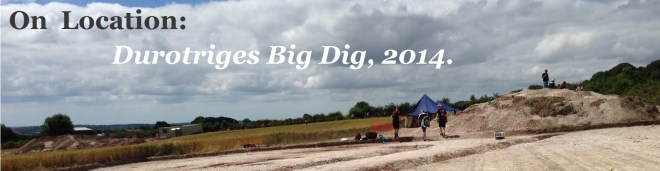
Today’s On Location is featuring the Durotriges Project, an excavation in Winterborne Kingston,  Dorset, UK, which is held by Bournemouth University.

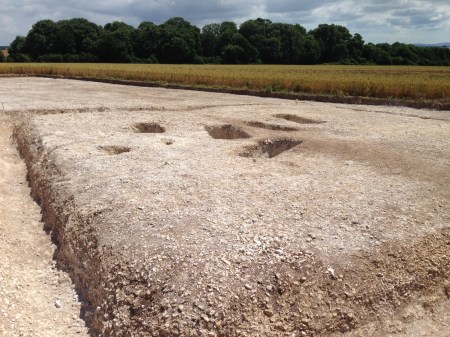
This archaeological site shows significant Iron Age and Roman settlement, particularly with the Durotriges tribe and Roman interaction. The Durotriges Project has been a yearly excavation, starting in 2009, which has uncovered many archaeological features. Over the past five years, the site has unearthed an Iron Age banjo enclosure, two Roman villas, an Iron Age burial site and numerous storage pits.

During this years excavation they were able to uncover a Bronze Age food preparation area surrounded by storage pits, and a flint mine – which was used to source the materials needed to construct the settlement’s buildings. Within the flint mine, students discovered the skeletal remains of an 18 month old juvenile.

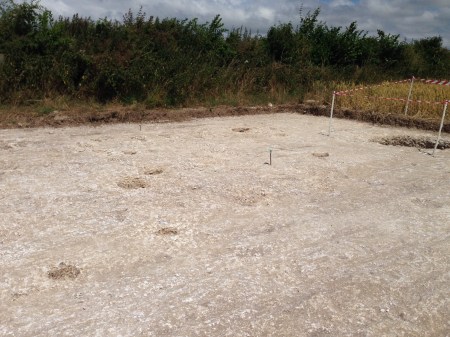
Food Prep area DBD2014

The Bronze Age food preparation area, defined by post holes with a hearth in the centre, that was discovered during the Durotriges Project 2014. A storage pit can be seen to the right.

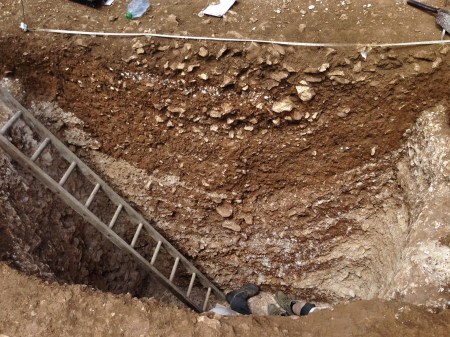
photo 3

The flint mine that was discovered in Trench 2. Within this flint mine, students unearthed the skeletal remains of an 18 month old juvenile.

The Durotriges Project recently hit the news this year with its discovery of five Roman burials. The burials, thought to date between 350AD to 380AD, were uncovered within a 15 by 15m  square enclosure around 100m away from the previously found Roman villa.

Roman Burials Within Enclosure

The five Roman era burials, dated between 350AD and 380AD, which were discovered within a square enclosure.

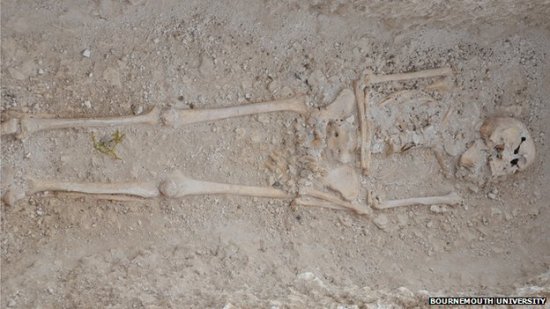
The skeletal remains found within the five graves have been identified as two males and three females. The males and two females have been aged between 40-50 years old, and the other female aged between 80-90 years old. The individuals were buried within coffins, with evidence of them being clothed as eyelets from their shoes were discovered.

Skeleton

One of the five Roman burials uncovered by the Durotriges Project.

It is thought that they were of “high status” as were buried with great care and with burial gifts. It is hoped that the individuals were the occupants of the nearby Roman villa, and that their discovery will help shed light about the Roman’s diet, heath and ancestry.

To learn more about Bournemouth University’s Durotriges Project’s other fascinating discoveries from the site, you can view their blog here. Follow them on Twitter, and keep up to date with them by liking their Facebook page!

Unusual-ology: 800 year old monk’s skeletal remains found in a cliff face.

The recent winter storms that rocked Britain have uncovered a lot of the isles’ hidden archaeology including a petrified forest in Wales, but it has also damaged many coastal heritage sites. In this case, the storms unearthed the skeletal remains of what is thought to be an 800-year-old medieval monk, which were found poking out of a cliff in Monknash, South Wales.

Image

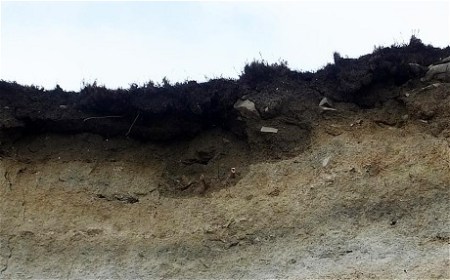
The femurs belonging to the monk, as they were found within the cliff face.

The skeletal remains were discovered by Mandy Ewington, a member of public out for a walk, who spotted the thigh bones of sticking out the side of a cliff. The femurs were later identified to belonging to a man of good health and in his late twenties, who may have been a monk.

From past excavations in the area and stratigraphic evidence, it is thought that the skeletal remains belonged to a monk from the 1200’s. The Monknash area is well known to have once been the home of Cistercian monks between 1129 and 1535, and was the site of a Middle Age burial ground.

Image

From stratigraphic evidence it is thought that the skeletal remains belonged to a monk from the 1200’s.

But due to the monk’s femurs being badly damaged by coastal erosion and were found unconnected to any other bones, it is difficult to come to a definite conclusion on whether or not the man truly did belong to the Cistercian monastery.

Unique Aztec Dog Burial Discovered.

Archaeologists from the National Institute of Anthropology and History (INAH) have uncovered twelve dog skeletons whilst excavating in the Aztec capital of Tenochtitlan. Dog burials are a common practice within archaeology, but what stands this particular discovery out from the crowd is that there is no human burial, or even building associated to this burial.

Image

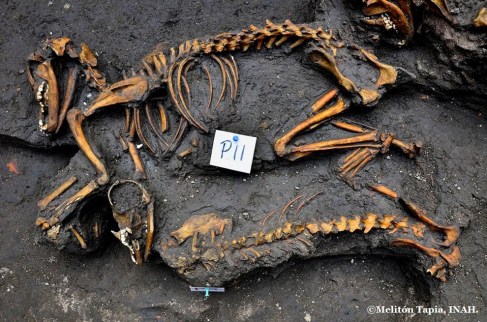
One of the well-preserved dog skeletons found.

The reason why dogs were often found alongside human burials is linked back to the animal’s symbolism in Aztec mythology. It was believed that even after death, dogs still served their masters. The belief was that the dogs helped guide the owner’s soul through the hazardous underworld until they safely reached Mictlan, the resting place of the dead.

Image

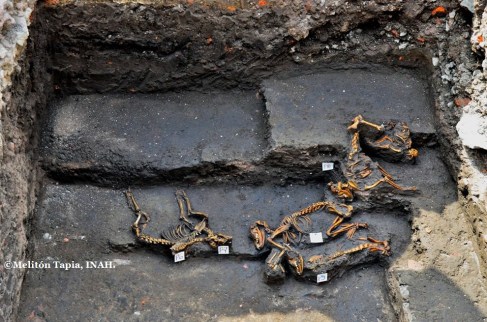
The placement of the dog skeleton’s have no pattern, leaving archaeologists wondering what is the significance behind this burial.

The dog’s skeletal remains have been date back to 500 years, and they were well-preserved and most were complete and articulated . Their placement within the burial ground has no discernible pattern to it, leaving the archaeologists wondering what the significance of this burial is, although archaeologists have deduced from the skeleton’s measurements that the dogs are likely to be common breeds as their stature are much taller than the native Mexican breed of Techichi.

Give-away: Etsy Handmade Archaeology/Anthropology Tool Roll Launch.

Etsy Header2

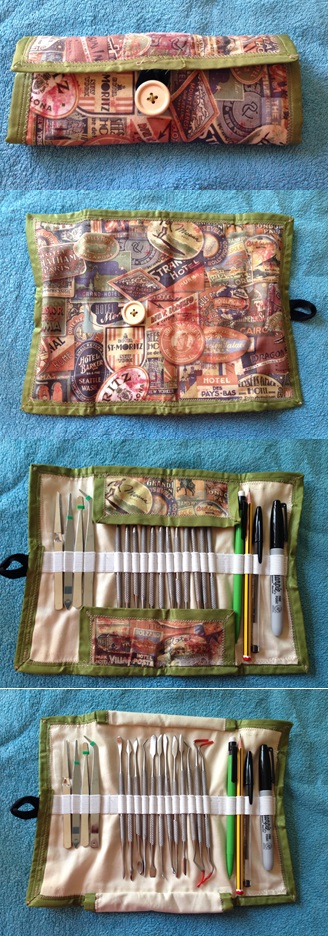
To celebrate the launch of our Etsy shop, which you can visit here https://www.etsy.com/uk/shop/AllThingsAAFS, we are giving away one of our hand-crafted ‘Archaeology Traveller’ small finds/anthropology tool kits (pictured below)!

Image

 The tool kit includes:

12x Stainless Steel Small Finds Archaeology Tools!
4x Tweezers – to allow you to delicately handle finds!
1x Sharpie permanent marker pen – for labelling tool find trays or bags!
1x Mechanical Pencil – to help you write when the weather is gloomy!
1x HB Pencil – to allow you to sketch your finds, and with extra room to add your own personal tools.
When opened the size of this tool roll is approximately 28x21cm, and will roll up to be 9x21cm.

To be in for a chance of winning this archaeology tool roll, just visit our competition Facebook post by clicking here and then ‘Like and Share’ it! Don’t forget to Like our page to receive updates from us!

Competition ends at 12:00pm on 12th March 2014, and the winner will be selected on the 14th March!

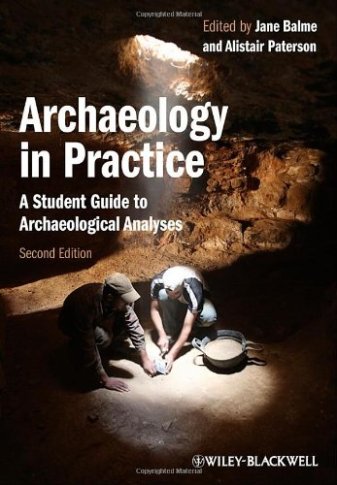
Textbook of the Week: Archaeology in Practice.

Every week we highlight one archaeology/anthropology textbook from our suggested readings, a full list of our suggested resources can be found here, on our Useful Literature page.

ImageArchaeology in Practice: A Student Guide to Archaeological Analyses (UK/Europe Link)

Archaeology in Practice: A Student Guide to Archaeological Analyses (US/Worldwide Link)

by Jane Balme and Alistair Paterson. Rating: ****

“This is THE book for how to apply archaeological methods in real life contexts. It is easy to follow, so perfect for first year students as it uses numerous case studies and illustrations to show you how to apply it in practice. I used this during my studies to wrap my head around how methods can be applied – which helped when methods were only briefly discussed in theory during my lectures.”

If you’re new to the realm of archaeological, anthropological and forensic sciences (AAFS), or are a student needing sturdy and reliable references, or wondering “what archaeology or anthropology textbooks to buy? Check out our new ‘Useful Literature’ page!

Image

Our Brand New Logo!

Our Brand New Logo!

Introducing our brand new logo, made up of the words that best represent All Things AAFS!

Hope you all like it!

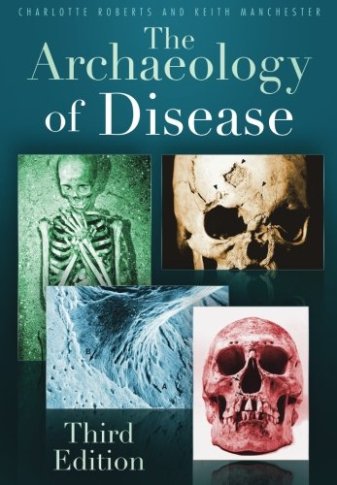
Textbook of the Week: Archaeology of Disease.

Every week we highlight one archaeology/anthropology textbook from our suggested readings, a full list of our suggested resources can be found here, on our Useful Literature page.

ImageThe Archaeology of Disease (UK/Europe)

The Archaeology of Disease (US/Worldwide Link)
(Click the links to have a peek inside the book)

by Charlotte Roberts and Keith Manchester. Rating: *****

“This is a essential if you’re studying diseases or taphonomy. It is fully illustrated with amazing case studies to display all diseases – ranging from simple fractures to malnutrition and infections.
Brilliant book, helped me a lot with my university Anthropology unit where I had to examine a bone and conclude which illness it had.”

If you’re new to the realm of archaeological, anthropological and forensic sciences (AAFS), or are a student needing sturdy and reliable references, or wondering “what archaeology or anthropology textbooks to buy? Check out our new ‘Useful Literature’ page!

Image

Unusual-ology: ‘Rare’ Prehistoric Spider Fossil Found.

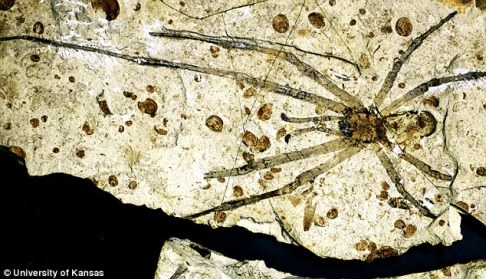
A fossil of a large male prehistoric spider has been recently found in the Daohugou beds of Inner Mongolia.  The spider’s species has stumped scientists, who have now proposed a new genus for the discovery called Mongolarachne.

Image

The male prehistoric spider fossil that was found in the Daohugou beds of Inner Mongolia.

This recent discovery comes after the previous unearthing of a female spider fossil in the same area back in 2011. The 165-million-year- old female spider is thought to have belonged to the Nephila species due to its size being close to the modern day Nephilidae (orb-weaver spiders), and was so called Nephila jurassica. But this newly discovered male spider fossil throws a spanner in the works.

While the male spider does resembles the Nephila jurassica, its shape and size has suggested it belonged to another genus. One factor that called for a new genus was its sex appendages, as they did not match those found on modern day Nephila males. Also the male has ‘spirals of hairlets’ that are more feathery than those on modern day orb-weavers.

Image

While the male spider (left) does resembles the Nephila jurassica (right), its shape and size has suggested it belonged to another genus.

These differences have led to Professor Paul Selden from Kansas University, who was part of the teams that discovered both fossils, and other scientists to propose the new genus Mongolarachne from the family Mongolarachnidae. According to Selden’s (2013) paper, these Mongolarachne closely resemble the modern day ogre-faced spiders that belong to the Deinopidae family.

Spider fossils are considered rare because of the soft composure of their bodies, but these two fossils were found within volcanic deposits. It is believed these deposits buried this pair at the bottom of a lake, therefore preserving them in very good condition.

References:

Selden, P.A., Shih, C., Ren, D. 2013. A giant spider from the Jurassic of China reveals greater diversity of the orbicularian stem group. Naturwissenschaften, 100:12. Pg 1171-1181.

If you’re new to the realm of archaeological, anthropological and forensic sciences (AAFS), or are a student needing sturdy and reliable references, or wondering “what archaeology or anthropology textbooks to buy? Check out our new ‘Useful Literature’ page!

Share Post Sign

Mystery Of Thirty Nine Skulls Discovered At London Wall Finally Solved.

In 1988, thirty-nine skulls were unearthed below the Guildhall in London. Their discovery left many unanswered questions, but after being recently re-examined – it is now believed that these skulls are the decapitated heads of gladiators.

Image

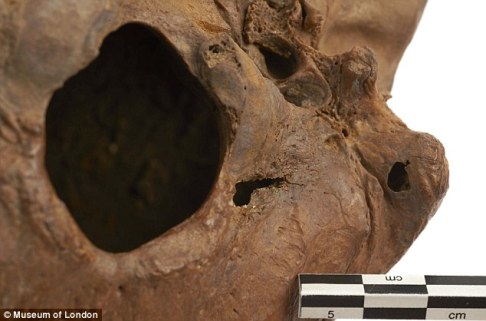
This Roman era skull, believed to belong to a gladiator, shows evidence of sharp force trauma.

Some of the skulls showed signs of ante and peri-mortem injuries, which Rebecca Redfern from the Museum of London, have interpreted as being the result of “sacrificial headhunting, or the remains of gladiators”.

One of the skulls showed evidence that a part of the jawbone had been cut away, which depicts that they were the victims of violence. Others showed multiple lethal blows to the head, as well as healed fractures. These are the first physical pieces of evidence that support that there were gladiators in London, even though it is widely known that this site once held an amphitheatre.

Image

Image

This mandible found at the Roman era site, shows evidence of sharp force trauma – leading experts to believe that these are the outcomes from being a gladiator in Roman London.

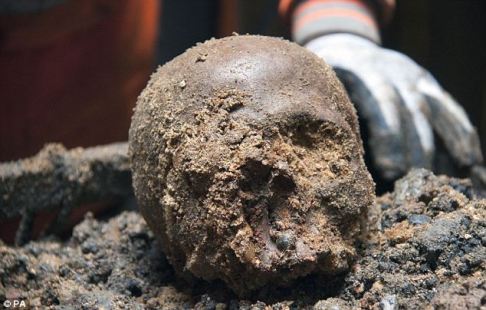
Another haul of Roman era skulls have been recently found close to this site. In August of 2013, a team of archaeologists unearthed two-dozen Roman-era skulls, which occurred whilst expanding the underground tunnels beneath Liverpool Street.

The skulls were found within the ancient river sediment deposits, which once belonged to the now extinct Walbrook River. It is thought that the skulls, along with pottery shards, were deposited onto a river bend after being washed away from a nearby burial ground.

Image

One of the two-dozen Roman era skulls found beneath London’s Liverpool Street Station.

These two-dozen Roman skulls have been loosely speculated to have belonged to victims of Queen Boudicca’s army, during her opposition to the Roman presence in Britain, dating around 61 A.D.

References:

Redfern, R., Bonney, H. 2014.  Headhunting and amphitheatre combat in Roman London, England: new evidence from the Walbrook Valley. Journal of Archaeological Science. Available here.

If you’re new to the realm of archaeological, anthropological and forensic sciences (AAFS), or are a student needing sturdy and reliable references, or wondering “what archaeology or anthropology textbooks to buy? Check out our new ‘Useful Literature’ page!

Share Post Sign