Quick Tips: How To Estimate The Chronological Age Of A Human Skeleton – Using Dentition To Age Subadults.

This Quick Tips post is the third in the series on age estimation of human skeletal remains, if you haven’t read the first post click here to start at the beginning. The first post provides an overview of the different techniques utilised by archaeologists/anthropologists, which will each be covered in more detail in their own blog post, and the categories that human skeletal remains are placed under according to their chronological age. The second post examines the epiphyseal closure method, which you can find here.

The practice of using dentition to chronologically age human skeletal remains is split into two halves, depending on the whether the skeleton is that of a subadult or adult. This blog post is going to discuss using dentition to age subadults.

Due to the abundance of teeth found in many archaeological, forensic, paleontological, and anthropological contexts and because of the regular tooth formation and eruption times, dental development is the most widely used technique for aging subadult remains. As stated in my previous blog post, several elements of the human skeleton begin the stages of epiphyseal fusion alongside the conclusion of tooth eruption; these two techniques (dentition and epiphyseal closure) are often used complementary to each other to help age sub-adults. When it comes to subadult tooth emergence there are four stages:

Stage 1 is where most of the deciduous teeth, commonly referred to as ‘milk teeth’, emerge during the second year of life.

Stage 2, during this stage the two permanent incisors and the first permanent molar emerge, this stage typically occurs between the age of six and eight years.

Stage 3, occurs between the age of ten and twelve and it involves the emergence of the permanent canines, premolars, and second molars.

Stage 4, or the final stage involves the third molar emerging around the age of eighteen years.

When looking at dentition you must look at all aspects of emergence and not just at the fully erupted tooth, which includes the completeness of all roots and crowns (formation) and the position of each tooth relative to the alveolar margin (eruption). Ubelaker (1989) conducted a study on non-Native Americans and created a graphic summary of dental development and the correlating ages it occurs, see figure 1.
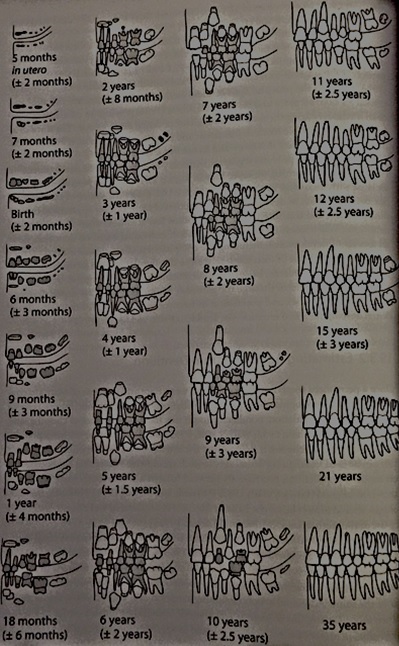
Figure 1: Ubelaker's (1989) diagram showing the dental development in correlation to age.

Figure 1: Ubelaker’s (1989) diagram showing the dental development in correlation to age.

It must be noted that the ages these stages occur at differ per individual so only act as a reference. Gustafson and Koch (1974) created a graph to illustrate the variation that could occur with dental development, see figure 2.

Figure 2: Gustafson and Koch's (1974) image showing the variation in timing of dental development. Colour key: Black highlights the age that crown mineralization begins, Dark grey shows the age of crown completion, Light grey shows the age of eruption, and White displays age of root completion.

Figure 2: Gustafson and Koch’s (1974) image showing the variation in timing of dental development. Colour key: Black highlights the age that crown mineralization begins, Dark grey shows the age of crown completion, Light grey shows the age of eruption, and White displays age of root completion.

References:

Gustafson, G. Koch, G. 1974. Age estimation up to 16 years of age based on dental development. Odontologisk Revy. 25. Pg 297-306.

Ubelaker, D.H. 1989. Human Skeletal Remains: Excavation, Analysis, Interpretation (2nd Ed.). Washington, DC: Taraxacum.

White, T.D., Folkens, P.A. 2005. The Human Bone Manual. San Diego, CA: Academic Press. Pg 360-385.

This is the third of a Quick Tips series on ageing skeletal remains, the next in this series will focus on the use of dentition to age adults and the use of cranial suture closure. To read more Quick Tips in the meantime, click here

To learn about basic fracture types and their characteristics/origins in their own Quick Tips series, click here!
 

Quick Tips: Named Fractures – Part One: Hand & Forearms

This blog post is the 3rd in its series on bone fractures. To view the first blog post on the basic fracture types and information, including open and closed fractures, click here.

This blog post will highlight some of the common ‘named’ fractures you will often find in archaeological and anthropological settings. It is important to know their characteristics and common causes to help establish what happened – whether the fracture was received by defensive or offensive action, or purely accidental. This blog post will examine the first five common fractures associated with the hand and forearm bones.

Image

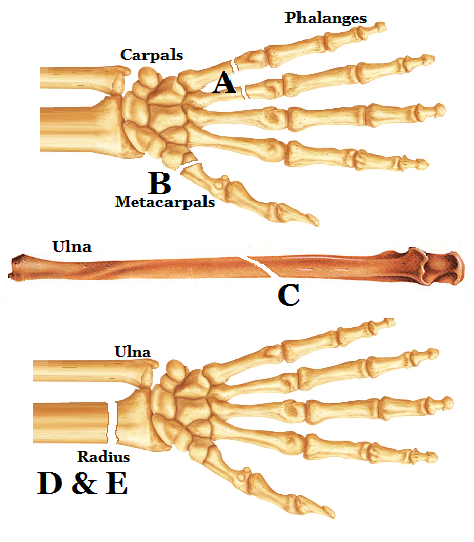
Common ‘Named’ Fractures of the forearms and hands: A) Boxer’s fracture, B) Bennett’s fractures, C) Parry’s or Monteggia’s fracture, D) Colles’ fractures, and E) Smith’s fractures.

The first two fractures we will look at affect the metacarpal bones;

A)     Boxer’s fracture: This fracture occurs due to the axial loading, meaning a force was applied along/parallel to the axis of the bone, on the transverse neck of the 4th and 5th metacarpal, secondary to an indirect force. A Boxer’s fracture often happens due to punching an object/person with a closed fist, hence the name ‘Boxer’ being associated to it.

B)      Bennett’s fracture: This fracture affects the 1st metacarpal (thumb) and extends into the carpometacarpal (CMC) joint which is complicated by subluxation (dislocation of a joint). A Bennett’s fracture is an oblique (See 1st blog post for meaning, click here) intra-articular metacarpal fracture caused by an axial force directed against the partially flexed metacarpal. This injury is also common when someone punches a hard object, but its most common cause is falling onto the thumb. An example of this is falling off a bike, as the thumb is extended around the handle bars.

The last three fractures affect the longbones of the forearm, the ulna and radius;

C)      Parry’s/Monteggia’s fracture: This fracture occurs on the proximal third of the ulna with subluxation of the radius/ulna. The most common cause of this fracture is by blunt force trauma caused by lifting the forearm up to protect the head or body in defence from an oncoming attack/striking object.

These two fractures affect the distal radius but cause displacement in two directions;

D)     Colles’ fracture: A Colles’ fracture, also known as a “dinner fork” or “bayonet” fracture, occurs when the distal radius is broken with dorsal displacement of the wrist and hand. This fracture is common when the person falls forwards and uses their outstretched hand to cushion the fall, which causes the force to displace and break the head of the radius.

E)      Smith’s fracture: A Smith’s fracture is the same as the Colles’ fracture but with ventral displacement of the broken radius head. The cause of a Smith’s fracture is the same as the Colles’ fracture, but it is less common.

Image

Fractures: D) Colles’ fracture, and E) Smith’s fracture.

The next Quick Tips post will discuss other ‘named fractures’ in archaeological/anthropological situations and their causes and characteristics.

This is the third post of a set on fractures, so keep your eyes open for the other posts, and the new ones to come. To view all the other Quick Tips posts click here!

Share Post Sign

Quick Tips: Forensic Entomology – An Introduction.

What is forensic entomology? It is a discipline within forensic sciences where specialists use information that they know about insect lifecycles and behaviours to interpret evidence in a legal context, relating to humans and animals. Entomologists don’t just stick to insects; their work can expand to include other arthropods, mites, spiders and macro-invertebrates.

Image

Insect species which are relevant to forensic entomology

What information can we learn from insect activity? Insects are everywhere and can hardly be avoided, so it’s no surprise that sometimes they get mixed up in the evidence left behind – making them extremely valuable to an investigation. Insects can be a vital part of forensic science as they can provide a time and date to a crime or even a geographical position to where it happened. As some insects only become apparent during certain months, they can become a biological calendar for when a crime might have been committed. As well as being a biological calendar, certain insect species are only native in specific countries or hemispheres. This can be used to create an ‘X marks the spot’ on where a crime was committed – even if a body was moved/buried. Because of this, insects can be the key to past and present events as well as the future.

The insects that are particularly relevant to forensic entomological investigations are blow flies (diptera), flesh flies, cheese skippers, hide and skin beetles, rove beetles and clown beetles. These forensically relevant insects can be placed in four categories:

  • Necrophages, which feed only on the decomposing tissue of the body or body parts. This is the category that blow flies, hide beetles and clown beetles are classed under.
  • Predators of the necrophages – for example the rove beetles and ground beetles.
  • Omnivores that consume both the live insects inhabiting the corpse and the dead flesh – ants and wasps.
  • Opportunist species, which arrive because the corpse is a part of their local environment. This is where mites, hoverflies, butterflies and occasionally spiders are classified.

Forensic entomologists use the evidence they gain from studying insects within legal cases in either civil or criminal courts. Civil court cases include:

  • Insect infestation in urban contexts.
  • Stored product infestations/pests.

Criminal court cases include:

  • Neglect – either animal or human (elderly and children).
  • Insect infestation of a body – living or dead.
  • Death in which foul play is suspected.

This is just an introduction into the world of forensic entomology, if you’d like to know more or further your knowledge on this topic check out this book, I found it very interesting and a terrific read:

  • Forensic Entomology: An Introduction (UK/Europe)
    Forensic Entomology: An Introduction (US/Worldwide Link)
    by Dorothy Gennard. Rating – ***
    “I used my this for my blog post on the basics of forensic entomology. It is perfect if you’re unsure on whether or not you want to pursue this career/discipline. Definitely a good read if your interest is sparked by Dr Hodgins from ‘Bones’, as it explained everything involved within entomology under legal settings.”

Unusual-ology – Medieval ‘Poison Ring’ Found in Bulgaria.

Unusual-ology is a new post type which focuses on weird new articles/science areas that have cropped up and caught my eye.

A medieval ring which could have once been used to poison unsuspecting dinner guests has been unearthed by archaeologists. The ‘poison ring’ has a hidden compartment which an envious attendee could fill up with poison and sneakily tip into his targets drink – unbeknown to them.

Image

The medieval ‘poison ring’ discovered in a fortress on Cape Kaliakra, Bulgaria.

The 14th Century ring was discovered by Bulgarian archaeologists at the site of a medieval fortress on Cape Kaliakra, Kavarna situated close to the Bulgarian Black Sea coast. The ring is thought to have belonged to a wealthy but power hungry male, that had political ambitions and so wished to ‘take out’ some of his competitors silently and discretely.

This is the first ring of its kind to have been discovered in Bulgaria according to the director Boni Petrunova, of the National Archaeology Institute and Museum in Sofia. Dr Petrunova has interpreted the find as a ‘poison ring’ due to the positioning of the hole being easily covered by another finger so that the poison could be dropped at a ‘moment’s notice.’

Image

The hole in which the poison would be poured into the ring to be easily ‘dropped at a moment’s notice’ into unsuspecting diners drinks.

This ring provides evidence that poison was used in politically-motivated murders in Medieval Bulgaria, but the poison found preserved inside would have originated from Spain or Italy. The ring also improves existing knowledge about the life on Cape Kaliakra, by further identifying that it was home to local aristocracy.

However, there are some disagreements between historians on whether the ring truly was used to deliver poison. Some archaeologists suggest that it was an unusual reliquary ring which was once used to store the remains of Saints.

If you want to read more unusual science posts click here, or to read the Unusual-ology post on the Ancient Egyptian use of lettuce as an aphrodisiac, click here. Or to read about the newly discovered ‘Entrance to Hell’ click here!

Quick Tips: How To Estimate The Chronological Age Of A Human Skeleton – Epiphyseal Closure Method.

This Quick Tips post is the second in the series on age estimation on skeletal remains, if you haven’t read the previous post click here. The previous post provides an overview of the different techniques utilised by archaeologists/anthropologists, which will each be covered in more detail in their own blog post, and the categories that human skeletal remains are placed under according to their chronological age.

One of the methods frequently used by archaeologists/anthropologists to estimate the chronological age of human remains is by studying the level of epiphyseal fusions.

But first what is an epiphysis? An epiphysis is the cap at the end of a long bone that develops from a secondary ossification center. Over the course of adolescence the epiphysis, which is originally separate, will fuse to the diaphysis. The ages of which epiphyseal fusion begins and ends are very well documented, with the majority of epiphyseal activity taking place between the ages of fifteen and twenty-three.

Epiphyses

Diagram showing where the epiphysis is found.

As epiphyseal fusions are progressive they are often scored as either being unfused (non-union), united, and fully fused (complete union). Females often experience the union of many osteological elements before males, and every individual experience epiphyseal union at different ages.

Left: Diagram of a skeleton showing the position of the different epiphyseal elements. Right: A graph displaying the timing of fusion of epiphyses for various for various human osteological elements. The grey horizontal bars depict the period of time, in ages, when the fusion is occurring. All of the data is representative of males, except where it is noted. Data taken from Buikstra & Ubelaker, 1994.

Left: Diagram of a skeleton showing the position of the different epiphyseal elements.
Right: A graph displaying the timing of fusion of epiphyses for various for various human osteological elements. The grey horizontal bars depict the period of time, in ages, when the fusion is occurring. All of the data is representative of males, except where it is noted. Data taken from Buikstra & Ubelaker, 1994.

Archaeologists/anthropologists use standards that are well known and documented, such as Buikstra & Ubelaker’s (1994) depicted in the above graph. From the above data we know that, for example, the fusion of the femur head to the lesser trochanter is begins around the age of fifteen and a half and ends around the age of twenty. So if a skeleton has evidence of an unfused femur head/lesser trochanter, there is a possibility of the skeleton having a chronological age of < fifteen years. If there is full union of the epiphyses then the skeleton is more than likely being > twenty years old. But it should be noted that individuals vary in their development so numerous elements should be examined before coming to an accurate conclusion.

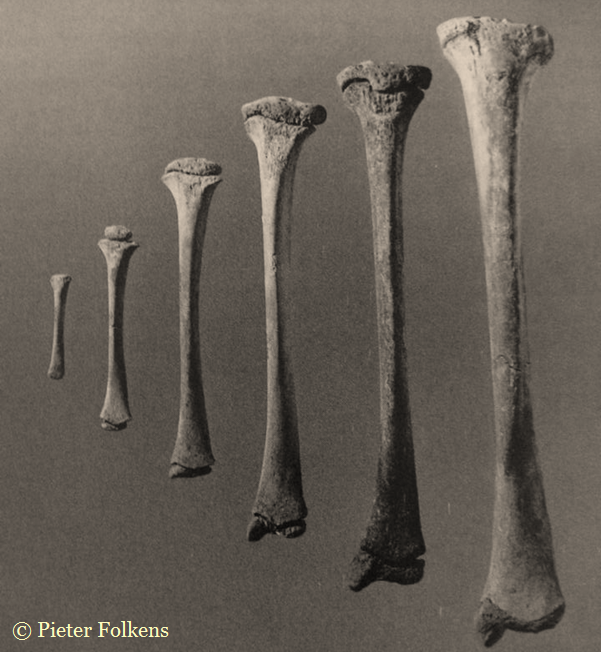
Different stages of epiphysis fusion of human tibias. Ages left to right: Newborn, 1.6 years old, six years old, ten years old, twelve years old and eighteen years old.

Different stages of epiphysis fusion of human tibias. Ages left to right: Newborn, 1.6 years old, six years old, ten years old, twelve years old and eighteen years old.

As several elements of the human skeleton begin the stages of epiphyseal fusion alongside the conclusion of tooth eruption, these two techniques (dentition and epiphyseal closure) are often used complementary to each other to help age sub-adults. The next post in this series on age estimation will focus on the use of dentition to aid with the chronological ageing of human remains.

References:

Buikstra, J.E., Ubelaker, D.H. 1994. Standards for Data Collection From Human Skeletal Remains. Fayetteville, Arkansas: Arkansas Archaeological Survey Report Number 44.

White, T.D., Folkens, P.A. 2005. The Human Bone Manual. San Diego, CA: Academic Press. Pg 360-385.

This is the second of a Quick Tips series on ageing skeletal remains, the next in this series will focus on the dentition method of ageing sub-adults. To read more Quick Tips in the mean time, click here

To learn about basic fracture types and their characteristics/origins click here!

Archaeologists Discover Tomb of Moche Priestess-Queen.

Archaeologists Discover Tomb of Moche Priestess-Queen.

The archaeologists, led by Luis Jaime Castillo Butters, discovered the tomb within the excavation site situated in San José de Moro, in the Jequetepeque River valley of northern Peru. The tomb belongs to what is believed to be a powerful Moche Priestess-Queen, who was buried 1,200 years ago and is thought to have been a prominent figure in Moche civilisation.

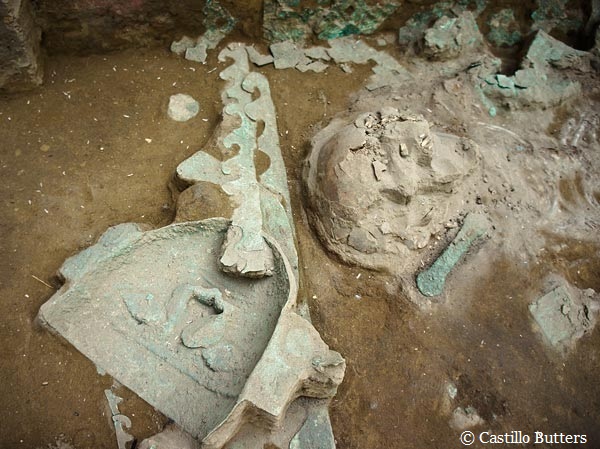
The tomb of the Moche Priestess-Queen, which was discovered six metres underground in San  José de Moro.

The tomb of the Moche Priestess-Queen, which was discovered six metres underground in San José de Moro.

The tomb consisted of a large chamber situated twenty feet underground and the large earthen walls of the tomb were painted red. The Priestess-Queen was found at one end of the chamber and resting on a low platform with a simple bead necklace, consisting of local stones, adoring her neck. Two adult skeletons were also found alongside the Priestess-Queen, who have been presumed to be sacrificed female attendants and five children were also buried in the tomb.

The most important clue that identified the female skeleton as a powerful Moche Priestess-Queen was a tall silver goblet that was found placed next to the skeleton. These silver goblets have been seen in numerous Moche art pieces, depicting scenes of human sacrifice and blood consumption. Other similar goblets were previously found in tombs of other Priestess-Queens.

Another clue to the female’s identity as an important person was the coffin itself. The coffin is assumed to have been made out of wood or cane, as it has decayed over the many centuries leaving only the copper plaques that covered it. The plaques trace out a typical Moche design, consisting of waves and steps, which now lay beside the skeleton where the wall of the coffin collapsed. Near the head of the skeleton was a copper funerary mask, which is thought to have been arranged on top of the coffin at the time of burial, and by the foot of the coffin were two pieces of copper shaped like sandals. Castillo Butters explains that “the coffin was anthropomorphised so that it became a person”.

The funerary mask discovered next to the Moche Priestess-Queen, who's skeleton can be seen in the background.

The funerary mask discovered next to the Moche Priestess-Queen, who’s skeleton can be seen in the background.

“The Moche seem to have believed that the identities that gave prominence to these individuals in life were to be maintained after death,” explains Castillo Butters. “Accordingly, they imbued their burials not only with symbols of religion and power, but [also] with the artifacts and costumes that allowed the priest and priestesses to continue performing their ritual roles in the afterlife.”

Click here to read about the Llullaillco Maiden, a 500yr old Inca child mummy, who was recently discovered to have been drugged before being sacrificed for the Incan ritual of Capacocha.

Quick Tips: How To Estimate The Chronological Age Of A Human Skeleton – The Basics.

Estimation of age-at-death involves observing morphological features in the skeletal remains, comparing the information with changes recorded for recent populations of known age, and then estimating any sources of variability likely to exist between the prehistoric and the recent population furnishing the documented data. This third step is seldom recognized or discussed in osteological studies, but it represents a significant element. – Ubelaker, D. 1989.

There are numerous markers on a human skeleton which can provide archaeologists and anthropologists with an estimate age of the deceased. The areas of the skeletal remains that are studied are:

If the skeletal marker listed above is a link, it means that I have already covered it in an individual blog post and can be found by following the link.

We can age skeletal remains to a rough estimate, as over a lifetime a human skeleton undergoes sequential chronological changes. Teeth appear and bone epiphyseal form and fuse during childhood and adolescence, with some bone fusing, metamorphose and degeneration carrying on after the age of twenty. Buikstra and Ubelaker, 1994, developed seven age categories that human osteological remains are separated into. The seven age classes are; fetus (before birth), infant (0-3 years), child (3-12 years), adolescent (12-20 years), young adult (20-35 years), middle adult (35-50 years), and old adult (50+ years).

When it comes to ageing skeletal remains, there are numerous problems. This is because individuals of the same chronological age can show difference degrees of development. Therefore, this causes archaeologists and anthropologists to obtain an accurate age estimate, which may not be precise.

It should be noted that it is a lot easier to deduce a juvenile/sub-adult’s age, as the ends of the limb bones form and fuse at known ages and the ages of which tooth formation and eruption occur are very well documented, although somewhat variable. After maturity there is little continuing skeletal change to observe, this causes adult ageing to become more difficult.

References:

Buikstra, J.E., Ubelaker, D.H. 1994. Standards for Data Collection From Human Skeletal Remains. Fayetteville, Arkansas: Arkansas Archaeological Survey Report Number 44.

Ubelaker, D.H. 1989. Human Skeletal Remains: Excavation, Analysis, Interpretation (2nd Ed.). Washington, DC: Taraxacum.

White, T.D., Folkens, P.A. 2005. The Human Bone Manual. San Diego, CA: Academic Press. Pg 360-385.

This is the first of a Quick Tips series on ageing skeletal remains, the next in this series will focus on the epiphyseal closure method of ageing sub-adults. To read more Quick Tips in the mean time, click here

To learn about basic fracture types and their characteristics/origins click here!

Quick Tips: Fracture Types – The Basics Pt 2.

In my previous Quick Tips, which you can find by clicking here, you were introduced to the first six basic types of fractures, what the main causes of fractures are, and the two main categories they are classed in. It is important that you know the information in the previous Quick Tips post before learning these last few basic fractures, as it discussed the fundamentals of fractures.

Basic Fracture Types:

Image

Fracture Types: A) Butterfly, B) Longitudinal, C) Segmented, D) Hairline, and E) Avulsion.

A) Butterfly Fracture: Butterfly fractures usually affect long bones and can be caused by car accidents or by being knocked side on.

B) Longitudinal Fracture: As a transverse fracture is a bone along the horizontal axis, a longitudinal fracture is along the vertical axis.

C) Segmented Fracture: This is when the bone has fractures in two parts of the same bone causing the bone to break into larger bone fragments which are separated from the main body of a fractured bone.

D) Hairline Fracture: These fractures are also known as ‘stress fractures’. These types of fractures are very difficult to diagnose and once they heal there may be no evidence left to see. These are very difficult, if not impossible to identify when in an archaeological context.

E) Avulsion Fracture: Avulsion fractures are characterised as the separation of a small fragment of bone at the site of attachment of a ligament or tendon.

The next Quick Tips post will discuss the ‘named fractures’ that can be discovered in archaeological contexts, such as the familiar Bennett’s and Parry’s fracture, and their origins and common causes.

This post was put together by using knowledge from my degree and supplemented with the textbook ‘The Archaeology of Disease’ by Charlotte Roberts & Keith Manchester. If you’re interested in the latest scientific and archaeological techniques used to understand the diseases of past populations, you should check it out!

This is the second post of a set on fractures, so keep your eyes open for the other posts. To view other Quick Tips posts click here!

Quick Tips: Fracture Types – The Basics.

In my previous Quick Tips post I addressed how to distinguish between ante, peri and post-mortem fractures, click here if you haven’t read it yet. 

In this Quick Tips post I will show you some ways to identify and deduce common fracture types and their key characteristics. The definition of a fracture is a break in the continuity of a bone. There are three major causes of fractures: acute injury (an accident); underlying disease which then weakens the bone making it susceptible to fractures; and repeated stress (as seen in athletes).

All fracture types can be placed in two categories; open and closed. An open fracture, also known as a compound fracture, is where the bone breaks through the skin causing an open wound. It is called an open fracture as there is an open connection between the fracture site and skin. A closed fracture is where the bone has no connection between the outer skin surface and the fractured bone itself; it does not cause an open wound. A closed fracture is classed as a ‘simple fracture’.

Basic Fracture Types:

Image

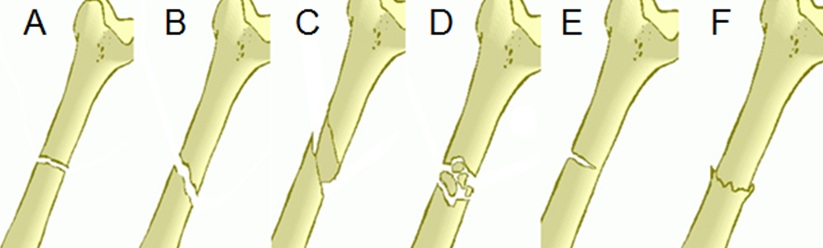
Fracture Types: A) Transverse, B) Oblique, C) Spiral, D) Comminuted, E) Greenstick, and F) Impacted fracture.

A) Transverse Fracture: This is when the break of a fracture is in a horizontal line, it is the simplest fracture type.

B) Oblique Fracture: This fracture is a break which extends in a slanting direction.  Oblique fractures are caused by indirect or rotational force.

C) Spiral Fracture: As you can guess from the name, this is a fracture which is characterised by a spiral. It is often denoted as being caused by torsion or force onto the bone.

D) Comminuted Fracture: A comminuted fracture is characterised from the splintering of the bone. This causes the fracture to be made up of two or more pieces. This fracture is common in road-traffic accidents and these fractures are less likely to heal in a functionally satisfactory manner.

E) Greenstick Fracture: This occurs when a transverse fracture is incomplete. This fracture is seen mainly in children due to their young, immature bones which rarely break the whole width.

F) Impacted Fracture: This occurs when the bone is broken and not displaced but the two fractured ends are forced together. This produces a rather stable fracture which can heal readily but there may be some length lost.

This post was put together by using knowledge from my degree and supplemented with the textbook ‘The Archaeology of Disease’ by Charlotte Roberts & Keith Manchester. If you’re interested in the latest scientific and archaeological techniques used to understand the diseases of past populations, you should check it out!

This is the first post of a set, click here to read the second post. To view other Quick Tips posts click here!

Unusual-ology: Ten Year Old Boy Finds ‘Egyptian Mummy’ In Grandmothers Attic.

Alexander Kettler, a ten year old boy from Diepholz in northern Germany, had a startling discovery in his grandmother’s attic when he stumbled upon what appears to be an Egyptian mummy in a mysterious wooden chest. The wooden box, which is covered in ancient hieroglyphs, was apparently bought in Africa around during the 1950’s by his late grandfather. But this Egyptian mummy isn’t all he found in the wooden chest. The chest also contained a death mask and a canopic jar, where the organs removed during the mummification process are stored.

Image

Image of the suspected Egyptian mummy in the hieroglyph covered sarcophagus.

The boy’s father now plans to take the mysterious box to Berlin to get it examined by experts to see whether this is a genuine mummy or a fake. He believes that the sarcophagus and jar are fake but the mummy might prove to be the real deal as it’s not “something you could buy at a shop around the corner”.

If the mummy is sent off for verification it will be subjected to MRI and CT scans, which may come back negative as mummies tend to be so dehydrated that there is a lack of hydrogen atoms – which the scans rely on. The use of carbon dating will be fundamental in identifying whether this is a true Egyptian mummy or a fake.

There are lots of problems occurring in the archaeological world, from fake mummies or mummies being wrongly labelled as something there not. One such example is my Unusual-ology post focusing on the topic of a lecture I had during my undergraduate degree. The lecture explored the past of a decapitated head which had preserved soft tissue, that was on display in a Wiccan and witchcraft museum under the guise of an execution victim, which was later stored in a decorated wooden box in a Church.

References:

BBC. 2013. German boy finds ‘a mummy’ in grandmother’s attic. BBC News. Available here. 

Daily Mail. Mummy there’s a mummy in grandma’s attic! Boy discovers ‘Egyptian body’ inside an old wooden chest. Available here. 

If you’ve enjoyed this new ‘Unsual-ology’ post feature – leave a comment or a like!

If you want to read more unusual science posts click here, or to read the Unusual-ology post on the Ancient Egyptian use of lettuce as an aphrodisiac, click here. Or to read about the newly discovered ‘Entrance to Hell’ click here!