Quick Tips: Use of Phytoliths in Archaeology.

Phytoliths are a very important identification tool in identifying plants within ancient environments, often even classifying down to the species of the plant.

But firstly, what are phytoliths? As the name phytolith suggests, coming from the Greek phyto- meaning plants and lith– meaning stone, they are tiny (less than 50µm) siliceous particles which plants produce. These phytoliths are commonly found within sediments, and can last hundreds of years as they are made of inorganic substances that do not decay when the other organic parts of the plant decay. Phytoliths can also be extracted from residue left on many different artefacts such as teeth (within the dental calculus), tools (such as rocks, worked lithics, scrapers, flakes, etc.) and pottery.

Image

Table 1 & 2: Examples of the descriptors found within the International Code for Phytolith Nomenclature (ICPN), 2005, for use of naming phytoliths.
Figure 1: A bulliform phytolith under a microscope, ©Henri-Georges Nation.

Phytoliths can form numerous striking shapes within the plant cells (figure 1), which gives them a characteristic shape, thus aiding the identification of plants. Due to the vast number of shapes and sizes that phytoliths can come in, researchers compiled the International Code for Phytolith Nomenclature (ICPN), 2005. The ICPN was developed to create a standard protocol which is to be used during the process of naming and describing a new or known phytolith type, as well as a glossary of descriptors to help aid with the naming.

To observe phytoliths, a sediment sample needs to be collected preferably away from any human settlements, as the use of agriculture may have introduced non-native plants to the area. The soil sample is then observed under microscope or even scanning electron microscope (SEM). On the discovery of a phytolith after observation it needs to be named using a maximum of three descriptors, the ICPN (2005) can be used to correctly identify what descriptors should be used.

The first descriptor should be of the shape, either using 3D or 2D descriptor (whichever is more indicative/shows the phytoliths symmetry). The orientation of the phytolith should also be noted. The second descriptor should describe the texture and/or ornamentation, if characteristic or diagnostic and not an artefact of weathering.
The third descriptor should be the anatomical origin, but only when this information is clear and beyond doubt (Madella et al, 2005).

Phytoliths are very important and useful if the sediment they are taken from is hostile to the preservation of fossil pollen, so may be the only evidence available for paleoenvironment or vegetation change.

References:

Balme, J., Paterson, A. 2006. Archaeology in Practice: A Student Guide to Archaeological Analayses. Oxford, UK: Blackwell Publishing. Pg 218.

Madella, M., Alexandre, A., Ball, T. 2005. International Code for Phytolith Nomenclature 1.0. Annals of Botany, 96: 253-260. A .pdf of this paper available here.  

Renfrew, C., Bahn, P. 1991. Archaeology: Theories, Methods and Practice. London, UK: Thames & Hudson. Pg 249-53.

Click here to read more Quick Tip posts!

Share Post Sign

Ancient Egyptian Physician’s Tomb Discovered.

A tomb dating back to 4,400 years ago, which is believed to have belonged to an Ancient Egyptian doctor has been discovered in Abusir, south of Cairo.

Image

The false door to Shepseskaf-Ankh’s tomb, discovered in Abusir, south of Cairo.

The tomb has been linked to a physician known as Shepseskaf-Ankh, whose name means “Shepseskaf is living”, due to the hieroglyphs which decorated the false door to the tomb. It is thought that Sheoseskaf-Ankh worked as the Head of Physicians of the Upper and Lower Egypt, whose duties included serving the royal household during the fifth dynasty, and has been linked to the king Niuserre, who reigned over Egypt for at least a decade.

The limestone tomb was discovered by a team of Czech archaeologists, led by Miroslav Bárta, from the Czech Institute of Egyptology. Bárta, has expressed how pleased he is concerning the historical details that the tomb contains as well as the high level of architectural preservation.

“Niuserre followed the policy of marrying some of his daughters to his top officials to keep their ambitions at bay. This is exactly the moment when the empire starts to break down due to rising expenses and increasing independence of powerful families,” explained  Bárta.

Abusir is part of the ‘great royal cemetery’ that’s found within a desert, west of the Nile, between Giza and Saqqara. The discovery of Shepseskaf-Ankh marks the third physician’s tomb to be found within this burial site. Other court officials as well as high-level priests were also buried in this site, keeping them close to their kings and rulers they served.

Share Post Sign

Unusual-ology: 4,000-year-old Human Brain Discovered.

A ‘petrified’ 4,000-year-old brain has been discovered in the Bronze Age settlement of Seyitömer Höyük, Turkey. The brain was excavated inside a skull that was uncovered in an ancient burial ground.  But how did the brain become ‘petrified’ and well-preserved?

Image

The ‘petrified’ brain found within a skull at the Bronze Age settlement of Seyitömer Höyük, Turkey. © Halic University Istanbul.

Meriç Altinoz, from the Haliç University in Istanbul, has theorised that due to how tectonically active the site is, an earthquake devastated the Bronze Age site. This earthquake would have flattened the settlement, burying everyone and starting a fire. The ancient burial ground shows evidence of the theorised fire due to the presence of charred skeletal remains and burnt wooden artefacts. This fire played a vital key in the preservation of the brain.  Due to the fire consuming a lot of the trapped oxygen within the rubble, the brain would have boiled in its own fluid. This boiling would have burned off the brain’s moisture preventing normal tissue decomposition.

But there is thought to be another factor to how it became so well preserved. The tissue of the brain was found to be full of magnesium, potassium and aluminium. These elements, when mixed with the fatty acids that are present in human tissue, make up adipocere, which effectively preserved the shape of the brain tissue.

This recent discovery of the oldest well-preserved brain tissue has opened up many new areas of study. Frank Rühli, of the Univerisity of Zurich in Switzerland, has noted that ‘the level of preservation in combination with the age is remarkable’ and in such cases could help understand ‘the history of neurological disorders’.

References:

Altinoz, M. A., Ince, B. Sav, A., Dincer, A., Cengiz, S., Mercan, S., Yazici, Z., Bilgen. M.N. 2013. Human Brains Found In A Fire-Affected 4000-years Old Bronze Age Tumulus Layer Rich In Soil Alkalines and Boron in Kutahya, Western Anatolia. HOMO – Journal of Comparative Human Biology, 64. Available from here.

Barras, C. 2013. Human brain boiled in its skull lasted 4000 years. New Scientist. 2937, page 11. Available from here. 

Fossum, M. 2013. 4,000 Year Old Preserved Human Brain Found in Turkey. Web Pro News.

Click here to read more Unusual-ology posts!

Share Post Sign

5,400-year-old Neolithic Bow and Arrows Found in Norway.

Due to the snow melting away in the Trollheim and Dovre mountains in Norway, well-preserved Neolithic hunting bow and arrows have been discovered by archaeologists from the Norwegian University of Science and Technology.

Image

The oldest Neolithic arrow, dating 5,400-years old, found due to the melting ice patches on the Trollheim and Dovre mountains.

The ancient bow and arrows, which are thought to have belonged to Stone Age reindeer hunters, have been dated back to around 3,800-years-old with the oldest arrow dating back to 5,400-years. The bow has been identified as being made from elm wood, with the elm trees being found in the lower altitudes of the mountain, whereas the arrow heads have been identified as slate. Their shape and design has been noted as being very similar to those found in other cold glacial locations, such as the Yukon. On the striking similarities, Dr Martin Callanan, who led the archaeological excavation, has noted that: ‘the people in Norway, they didn’t have any contact with people in the Yukon, but they have the same type of adaption.’ This highlights how two different cultures, allopatrically separated, can adapt using similar techniques to overcome similar environmental challenges.

These ancient hunting artefacts were discovered in a patch of melting snow over the recent summers. Dr Callanan, has commented that the discovery is ‘a little bit unnerving’ due to the age of the artefacts and that they’re being discovered right now, owing to the changing levels of snow. But this isn’t the only recent archaeological discovery which was caused due to melting snow.

Image

The reducing snow patches on the Trollheim and Dovre mountains. A) Photo taken on the 20th August 2010. B) Photo taken on 1st September 2008. (Callanan, 2013)

An intact jumper crafted from woven wool, dating between 230AD and 390AD, was discovered in the hunting area of the Norwegian Lendbreen glacier. ‘Due to global warming, rapid melting of snow patches and glaciers is taking place in the mountains of Norway as in other parts of the world, and hundreds of archaeological finds emerge from the ice each year’ commented Marianne Vedeler from the University of Oslo, and Lise Bender Jørgensen, from the Norwegian University of Science and Technology in Trondheim. But is this sudden emergence of well-preserved artefacts something to worry about?

Image

The well preserved wooly jumper found by Marianne Vedeler, from the University of Oslo and Lise Bender Jørgensen, from the Norwegian University of Science and Technology in Trondheim.

E. James Dixon, director of the Maxwell Museum of Anthropology at the University of New Mexico, has commented that if climate change is causing the ancient snow to melt, it is bad for archaeology. This is because the artefacts buried in the ice can be preserved for thousands of years, but when the ice melts and the artefacts become exposed to the current environment, they can quickly decompose. ‘For every artefact we find, there are probably hundreds, maybe thousands, which are lost and destroyed for ever.’

References:

Callanan, M. 2013. Melting snow patches reveal Neolithic Archery. Antiquity 87: 728-745. A .pdf of this interesting journal can be found here. 

Daily Mail. 2013. Melting snow reveals remarkably well-preserved 5,400-year-old bow and arrows used to hunt reindeer in Norway. Daily Mail Online.

Daily Mail. 2013. Has global warming sparked an archaeological bonanza? Melting ice reveals 1,700-year-old woolly jumper – and experts say there is much more to come. Daily Mail Online.


Share Post Sign

Unusual-ology: Beheaded Massacre Victims Found in 1,400 Year Old Mayan Mass Grave.

Unusual-ology: Beheaded Massacre Victims Found in 1,400 Year Old Mayan Mass Grave.

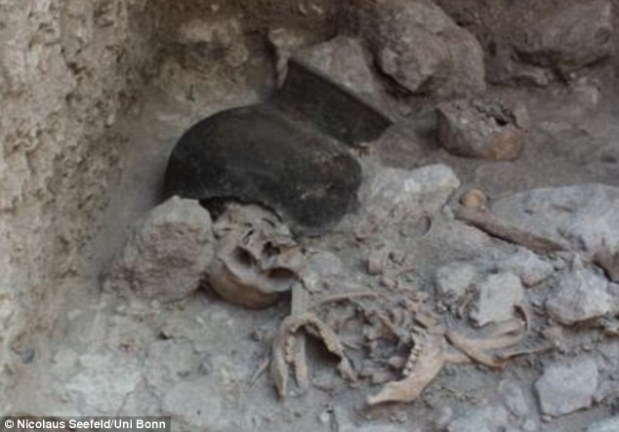
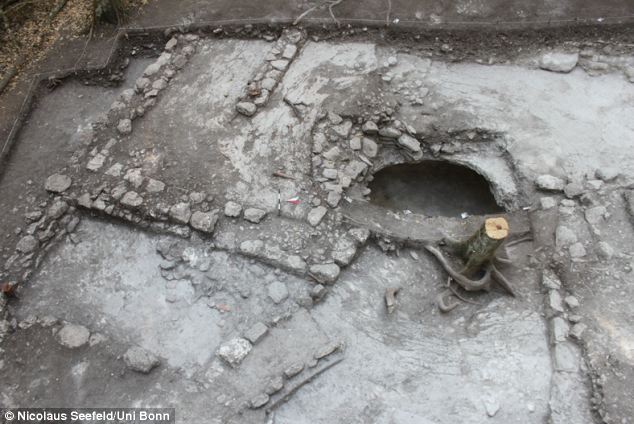
Archaeologists have discovered a 7th-century mass grave in the Mayan city of Uxul, Mexico. The mass grave contained the dismembered skeletal remains of twenty-four victims. Nicolaus Seefield, from the University of Bonn, who made this discovery has interpreted the skeletal remains as those belonging to prisoners of war and the grave being the site of a Mayan water reservoir.

Image

The twenty-four dismembered skeletal remains were found within a Mayan water reservoir.

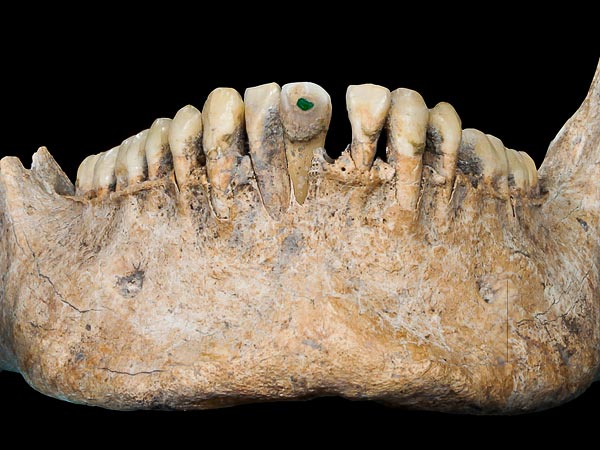
Due to being covered in a layer of clay, the victim’s skeletons were very well preserved enabling fifteen of the twenty-four skeletons to be chronologically aged and sexed. The age of the skeletons ranged between eighteen and forty-two years old, with thirteen of the skeletons being males. From looking at the skeleton’s dentition there is evidence of severe tooth decay and malnutrition, with a few of the skeletons teeth showing evidence of jade tooth inserts. The jade inserts are thought to be a sign of nobility, which could in the future help identify the victims of this massacre.

Image

A victim’s mandible showing a jade insert within a tooth, which is thought to be a sign of nobility.

The skeletons were badly dismembered with body parts strewn across the floor of the mass grave. Seefield observed ‘complete legs, whose bones were still in the correct anatomical articulation from the hip, to the femur, the kneecaps until the smallest toe-bones. Apart from that I also observed other detached body parts such as severed heads, complete hands, detached feet.’ The skeletal remains also displayed evidence of blunt force trauma on the foreheads, and cuts from sharp Mayan blades on parts of the skull.

Image

A massacre victim’s skull displaying evidence of the top portion of the skull being cut off.

Image

A victims foot displaying proper articulation, which means that the foot was severed from the body before being placed in the mass grave.

Seefield has noted the significance of this Mayan find, ‘It is absolutely rare to find such a mass grave in the Maya area. The only other archaeological evidence of such dismemberment of victims was in the site of Cancuén, Guatemala.’

Lead by Dr Nikolai Grube and Dr Kai Delvendakl from the University of Bonn, and Dr Antonio Benavides belonging to the Mexican National Institute of Anthropology and History (NIAH), archaeologists have been excavating this historical Mayan city for the past five years in search of uncovering the origins and collapse of the regional states in the Mayan lowlands. There are already plans in place to excavate the western half of the water reservoir in the hope that more Mayan artefacts.

Share Post Sign

Quick Tips: How To Estimate The Chronological Age Of A Human Skeleton – Cranial Suture Closure Method.

This is the 4th blog post in this Quick Tips series on chronologically dating human skeletal remains, if you haven’t read the first post click here to start at the beginning. In my previous blog post I introduced the method of chronologically dating sub-adults using dentition, you can find out this information by clicking here.

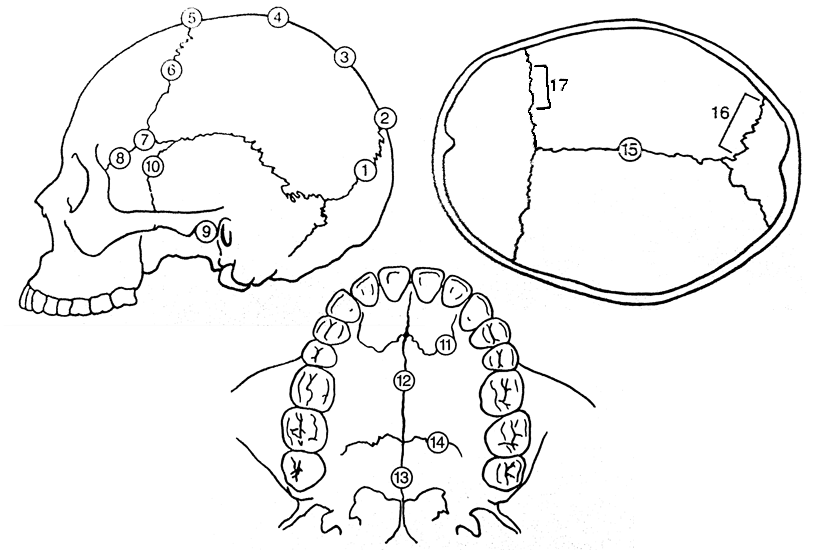
Another method of chronologically aging human skeletal remains is by observing the cranial suture closure sites. The human skull has seventeen unique cranial fusion sites (Figure 1), that are positioned on the vault, the lateral-anterior sites, and the maxillary suture. The seventeen sites are:

  1. Midlambdoid                                           10.Superior sphenotemporal
  2. Lambda                                                    11. Incisive suture
  3. Obelion                                                    12. Anterior median palatine
  4. Anterior sagittal                                      13. Posterior median palatine
  5. Bregma                                                    14. Transverse palatine
  6. Midcoronal                                              15. Sagittal (endocranial)
  7. Pterion                                                     16. Left lambdoidal (endocranial)
  8. Sphenofrontal                                         17.Left coronal (endocranial)
  9. Inferior sphenotemporal
Image

Figure 1) Diagram showing the seventeen cranial suture sites.

The first seven fusion sites are on the vault, and the lateral-anterior sites consist of numbers six to ten. Each suture is usually given a numerical score, the score of 0-3 is recommended by the Buikstra and Ubelaker standards (1994). The Buikstra and Ubelaker (1994) scoring system is as follows;

  • 0 is given when the suture is open, meaning there is no evidence of ectocranial closure.
  • 1 is given where there is a minimal closure of the suture.
  • 2 is given to sutures with evidence of significant closure.
  • 3 is given to a completely obliterated suture (complete fusion).

So to attain the age of a skeletal remain you would total the scores for each grouping of sites, vault (1-7) or lateral anterior (6-10), and by comparing the scores to the known composite scores vs. chronological age of Meindl And Lovejoy, 1985 (Figure 2).

Image

Figure 2: Table demonstrating Meindl and Lovejoy (1985)’s composite scores of the sutures on the vault and lateral-anterior, respectively, in relation to mean chronological age.

A very useful cranial suture site is the sphenooccipital synchrondrosis, because at least 95% of all individuals have fusion here between the ages of twenty and twenty-five, with most individuals experiencing complete fusion around the age of twenty-three (Krogman and Işcan, 1986).

References:

Buikstra, J.E., Ubelaker, D.H. 1994. Standards for Data Collection From Human Skeletal Remains.Fayetteville, Arkansas: Arkansas Archaeological Survey Report Number 44.

Krogman, W.M., Işcan, M.Y. 1986. The Human Skeleton in Forensic Medicine (2nd Ed). Springfield, Illinois: C.C. Thomas.

Meindl, R.S., Lovejoy, C.O. 1985. Ectocranial Suture Closure: A Revised Method For The Determination Of Skeletal Age At Death Based On The Lateral-Anterior Sutures. American Journal of Physical Anthropology. 68, 57-66.

White, T.D., Folkens, P.A. 2005. The Human Bone Manual. San Diego, CA: Academic Press. Pg 360-385.

This is the forth of a Quick Tips series on ageing skeletal remains, the next in this series will focus on the use of the pubic symphyseal surface to chronologically age skeletal remains. To read more Quick Tips in the meantime, click here

To learn about basic fracture types and their characteristics/origins in their own Quick Tips series, click here!

Share Post Sign

Porthkerry Country Park’s hidden archaeological secret.

Due to the weather being exceptionally hot and sunny whilst I’m still in Cardiff, I thought it would be a lovely time for a day trip to Porthkerry Country Park. I have visited Porthkerry Country Park many times in my life and only really noticed the immense viaduct that dominates the skyline, but today I found a hidden medieval gem within the woods surrounding the Country Park.

Image

Porthkerry Country Park’s viaduct.

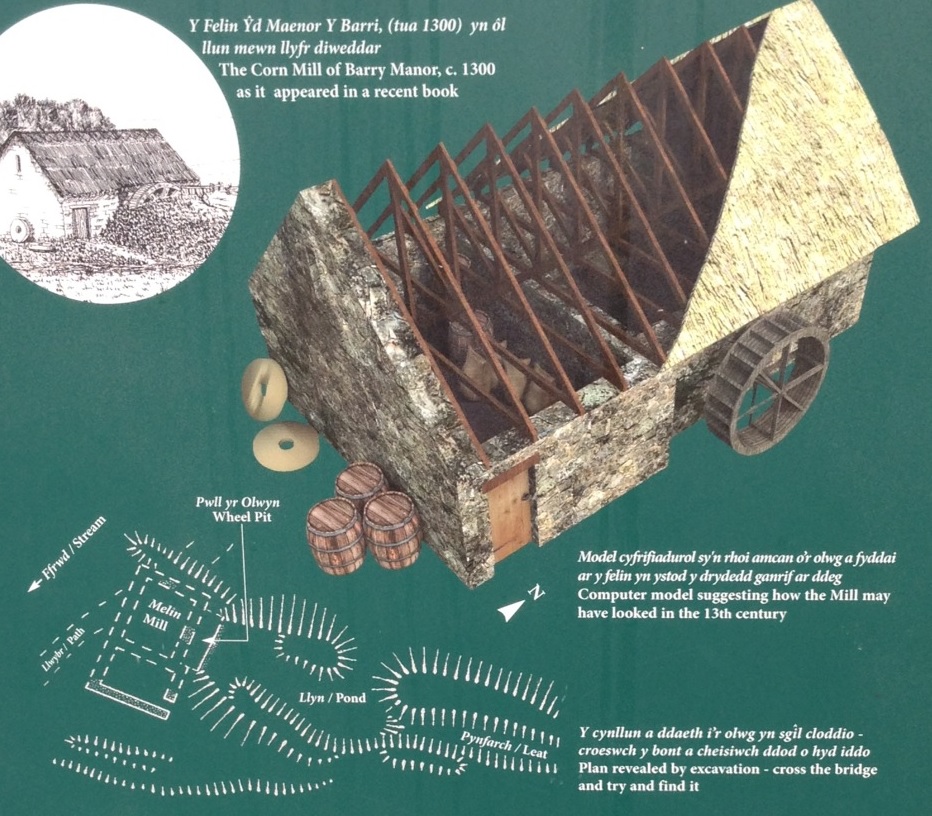
I found out that in Cliffwood resides a medieval Mill, dating back to the 13th century. The Mill, where they would process corn, is thought to have been built by the farming community within the ancient manor of Barry.

Image

Computer model of the 13th century corn Mill. ©Cadw

The Mill was thought to have been a two-roomed structure with the inner room containing the machinery for the mill. The machinery would have been powered by an overshot waterwheel which was supplied from a small holding pond above the mill. The water that filled the pond was fed with water from a leat, a hand-cut channel, diverted from Barry Brook opposite from the Nightingale cottage. It is estimated that the leat is roughly 500 metres long, with evidence still remaining of its vast length. There is also archaeological evidence that the Mill was abandoned sometime in the 14th century after a fire.

Image

The Mill hidden amongst Porthkerry’s Cliffwood.

Image

Current day remains of the 13th century corn Mill.

I absolutely love stumbling upon any hidden archaeological gem but today’s medieval mill in one of South Wales’ most beautiful country parks was purely found by chance. Porthkerry Country park not only has a medieval Mill within it’s grounds, the beach also has an amazing cliff where you can really see the different layers making up the stratigraphy.

Image

The cliffs to the left of the Porthkerry pebble beach, showing the different stratification layers.

Quick Tips: How To Estimate The Chronological Age Of A Human Skeleton – Using Dentition To Age Subadults.

This Quick Tips post is the third in the series on age estimation of human skeletal remains, if you haven’t read the first post click here to start at the beginning. The first post provides an overview of the different techniques utilised by archaeologists/anthropologists, which will each be covered in more detail in their own blog post, and the categories that human skeletal remains are placed under according to their chronological age. The second post examines the epiphyseal closure method, which you can find here.

The practice of using dentition to chronologically age human skeletal remains is split into two halves, depending on the whether the skeleton is that of a subadult or adult. This blog post is going to discuss using dentition to age subadults.

Due to the abundance of teeth found in many archaeological, forensic, paleontological, and anthropological contexts and because of the regular tooth formation and eruption times, dental development is the most widely used technique for aging subadult remains. As stated in my previous blog post, several elements of the human skeleton begin the stages of epiphyseal fusion alongside the conclusion of tooth eruption; these two techniques (dentition and epiphyseal closure) are often used complementary to each other to help age sub-adults. When it comes to subadult tooth emergence there are four stages:

Stage 1 is where most of the deciduous teeth, commonly referred to as ‘milk teeth’, emerge during the second year of life.

Stage 2, during this stage the two permanent incisors and the first permanent molar emerge, this stage typically occurs between the age of six and eight years.

Stage 3, occurs between the age of ten and twelve and it involves the emergence of the permanent canines, premolars, and second molars.

Stage 4, or the final stage involves the third molar emerging around the age of eighteen years.

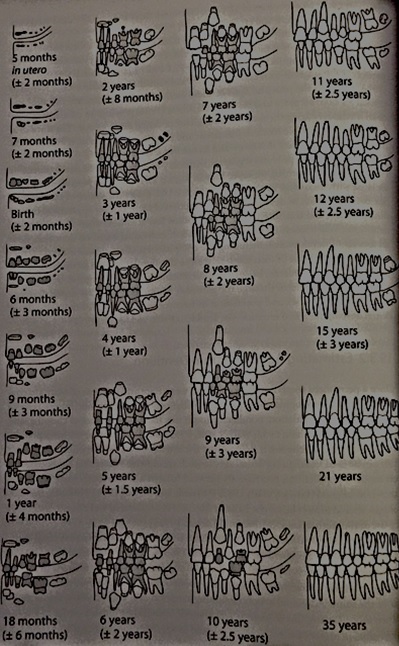
When looking at dentition you must look at all aspects of emergence and not just at the fully erupted tooth, which includes the completeness of all roots and crowns (formation) and the position of each tooth relative to the alveolar margin (eruption). Ubelaker (1989) conducted a study on non-Native Americans and created a graphic summary of dental development and the correlating ages it occurs, see figure 1.

Figure 1: Ubelaker's (1989) diagram showing the dental development in correlation to age.

Figure 1: Ubelaker’s (1989) diagram showing the dental development in correlation to age.

It must be noted that the ages these stages occur at differ per individual so only act as a reference. Gustafson and Koch (1974) created a graph to illustrate the variation that could occur with dental development, see figure 2.

Figure 2: Gustafson and Koch's (1974) image showing the variation in timing of dental development. Colour key: Black highlights the age that crown mineralization begins, Dark grey shows the age of crown completion, Light grey shows the age of eruption, and White displays age of root completion.

Figure 2: Gustafson and Koch’s (1974) image showing the variation in timing of dental development. Colour key: Black highlights the age that crown mineralization begins, Dark grey shows the age of crown completion, Light grey shows the age of eruption, and White displays age of root completion.

References:

Gustafson, G. Koch, G. 1974. Age estimation up to 16 years of age based on dental development. Odontologisk Revy. 25. Pg 297-306.

Ubelaker, D.H. 1989. Human Skeletal Remains: Excavation, Analysis, Interpretation (2nd Ed.). Washington, DC: Taraxacum.

White, T.D., Folkens, P.A. 2005. The Human Bone Manual. San Diego, CA: Academic Press. Pg 360-385.

This is the third of a Quick Tips series on ageing skeletal remains, the next in this series will focus on the use of dentition to age adults and the use of cranial suture closure. To read more Quick Tips in the meantime, click here

To learn about basic fracture types and their characteristics/origins in their own Quick Tips series, click here!


Quick Tips: Named Fractures – Part One: Hand & Forearms

This blog post is the 3rd in its series on bone fractures. To view the first blog post on the basic fracture types and information, including open and closed fractures, click here.

This blog post will highlight some of the common ‘named’ fractures you will often find in archaeological and anthropological settings. It is important to know their characteristics and common causes to help establish what happened – whether the fracture was received by defensive or offensive action, or purely accidental. This blog post will examine the first five common fractures associated with the hand and forearm bones.

Image

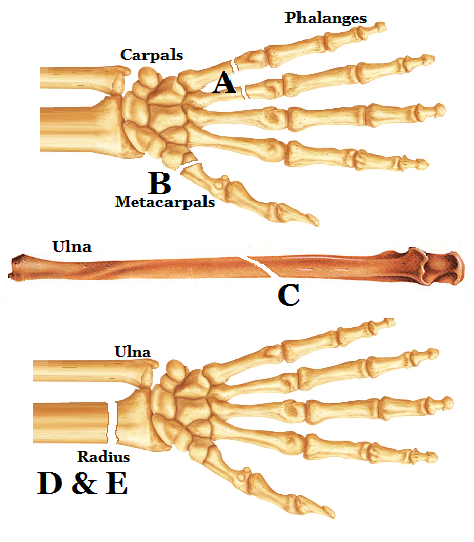
Common ‘Named’ Fractures of the forearms and hands: A) Boxer’s fracture, B) Bennett’s fractures, C) Parry’s or Monteggia’s fracture, D) Colles’ fractures, and E) Smith’s fractures.

The first two fractures we will look at affect the metacarpal bones;

A)     Boxer’s fracture: This fracture occurs due to the axial loading, meaning a force was applied along/parallel to the axis of the bone, on the transverse neck of the 4th and 5th metacarpal, secondary to an indirect force. A Boxer’s fracture often happens due to punching an object/person with a closed fist, hence the name ‘Boxer’ being associated to it.

B)      Bennett’s fracture: This fracture affects the 1st metacarpal (thumb) and extends into the carpometacarpal (CMC) joint which is complicated by subluxation (dislocation of a joint). A Bennett’s fracture is an oblique (See 1st blog post for meaning, click here) intra-articular metacarpal fracture caused by an axial force directed against the partially flexed metacarpal. This injury is also common when someone punches a hard object, but its most common cause is falling onto the thumb. An example of this is falling off a bike, as the thumb is extended around the handle bars.

The last three fractures affect the longbones of the forearm, the ulna and radius;

C)      Parry’s/Monteggia’s fracture: This fracture occurs on the proximal third of the ulna with subluxation of the radius/ulna. The most common cause of this fracture is by blunt force trauma caused by lifting the forearm up to protect the head or body in defence from an oncoming attack/striking object.

These two fractures affect the distal radius but cause displacement in two directions;

D)     Colles’ fracture: A Colles’ fracture, also known as a “dinner fork” or “bayonet” fracture, occurs when the distal radius is broken with dorsal displacement of the wrist and hand. This fracture is common when the person falls forwards and uses their outstretched hand to cushion the fall, which causes the force to displace and break the head of the radius.

E)      Smith’s fracture: A Smith’s fracture is the same as the Colles’ fracture but with ventral displacement of the broken radius head. The cause of a Smith’s fracture is the same as the Colles’ fracture, but it is less common.

Image

Fractures: D) Colles’ fracture, and E) Smith’s fracture.

The next Quick Tips post will discuss other ‘named fractures’ in archaeological/anthropological situations and their causes and characteristics.

This is the third post of a set on fractures, so keep your eyes open for the other posts, and the new ones to come. To view all the other Quick Tips posts click here!

Share Post Sign

Unusual-ology – Medieval ‘Poison Ring’ Found in Bulgaria.

Unusual-ology is a new post type which focuses on weird new articles/science areas that have cropped up and caught my eye.

A medieval ring which could have once been used to poison unsuspecting dinner guests has been unearthed by archaeologists. The ‘poison ring’ has a hidden compartment which an envious attendee could fill up with poison and sneakily tip into his targets drink – unbeknown to them.

Image

The medieval ‘poison ring’ discovered in a fortress on Cape Kaliakra, Bulgaria.

The 14th Century ring was discovered by Bulgarian archaeologists at the site of a medieval fortress on Cape Kaliakra, Kavarna situated close to the Bulgarian Black Sea coast. The ring is thought to have belonged to a wealthy but power hungry male, that had political ambitions and so wished to ‘take out’ some of his competitors silently and discretely.

This is the first ring of its kind to have been discovered in Bulgaria according to the director Boni Petrunova, of the National Archaeology Institute and Museum in Sofia. Dr Petrunova has interpreted the find as a ‘poison ring’ due to the positioning of the hole being easily covered by another finger so that the poison could be dropped at a ‘moment’s notice.’

Image

The hole in which the poison would be poured into the ring to be easily ‘dropped at a moment’s notice’ into unsuspecting diners drinks.

This ring provides evidence that poison was used in politically-motivated murders in Medieval Bulgaria, but the poison found preserved inside would have originated from Spain or Italy. The ring also improves existing knowledge about the life on Cape Kaliakra, by further identifying that it was home to local aristocracy.

However, there are some disagreements between historians on whether the ring truly was used to deliver poison. Some archaeologists suggest that it was an unusual reliquary ring which was once used to store the remains of Saints.

If you want to read more unusual science posts click here, or to read the Unusual-ology post on the Ancient Egyptian use of lettuce as an aphrodisiac, click here. Or to read about the newly discovered ‘Entrance to Hell’ click here!